I am from Auburn, AL, a college town and home of Auburn University, and one thing that has always amused me since becoming a trademark lawyer is how much the University’s “Tigers” branding has suffused the community. From the Tiger Rags clothing store to the Tiger Tire & Auto repair shop to the Tiger Town mall in next-door Opelika, “Tiger” branding feels like it is everywhere.
Just for fun, I used TM TKO’s new business listing data to do a bit of research on the commonality of team nicknames in local company names in the combined statistical areas (CSAs, geographic regions set up by the Office of Management and Budget) near the university. A completely random assortment of schools and names:
Badgers near Madison: 200+ Bruins in LA: 590+ Buckeyes near Columbus: 500+ Bulldogs (or Dawgs) near Athens/Atlanta: 150+ Crimson in Boston: 20+ Huskies in Seattle: 20 Tigers near Auburn: 40+ Volunteers (or Vols) near Knoxville: 200+ Wolverines near Ann Arbor/Detroit: 140+
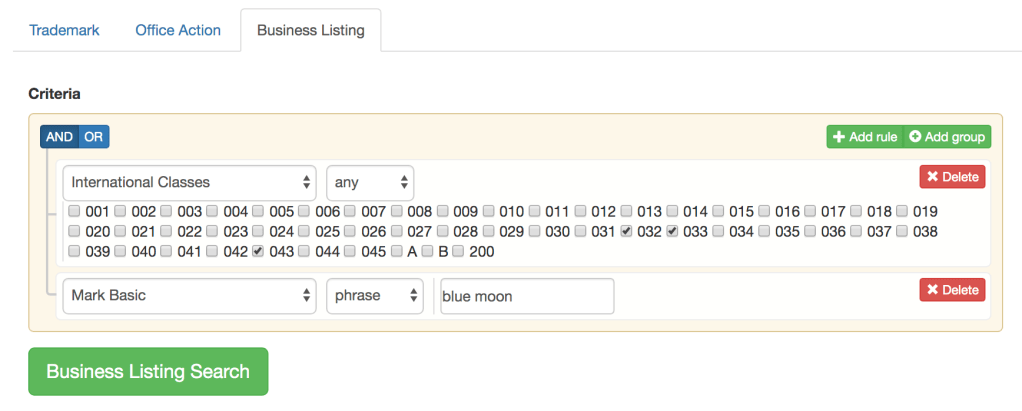
To do this sort of research, just go to the manual search tool and the Business Listing section.
TM TKO is happy to announce that we are in the process of incorporating common-law business entity data into the TM TKO platform. How will we make use of this new data set?
Manual Search
The first place you will see this is in manual search, the Search option in your top menu. The “Business Listing” tab lets you search by a variety of fields, including a wide range of name search options, geographical options (including state and regional CSA data), SIC codes, and the International Class equivalents of common SIC codes. How can you use this?
This is immediately a valuable adjunct to your clearance efforts. Just plug in a key term from your mark, limit to an international class (and/or its coordinated classes), and you’re off and running with additional results.
In an Office Action Response or TTAB proceeding, evidence of common-law co-existence can be extremely valuable. For instance, the Federal Circuit strongly emphasized the importance of common-law uses of the term “Blue Moon” in the food and restaurant space. In re Coors Brewing, Co., 343 F.3d 1340, 68 USPQ2d 1059, 1061 (Fed. Cir. 2003). Let’s create a quick search to identify this sort of data.
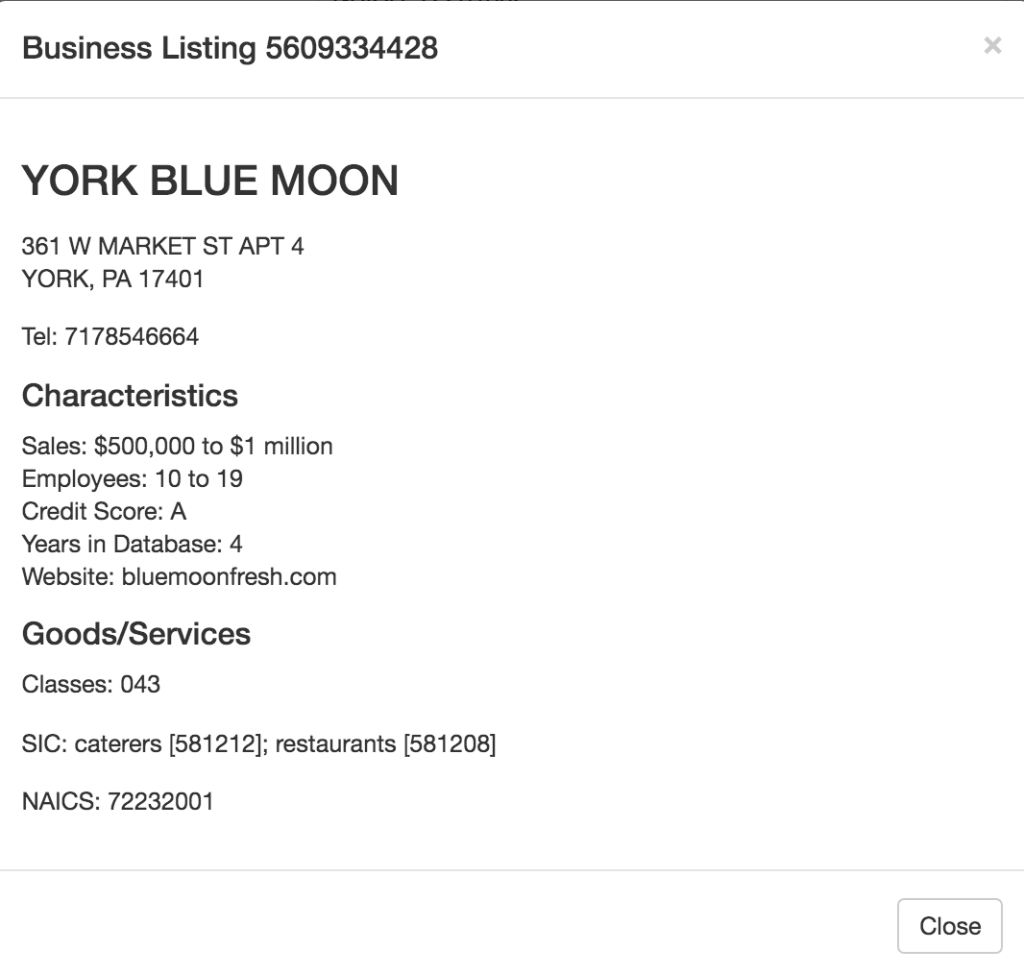
You can quickly identify nearly 200 “Blue Moon” marks in the space, from restaurants to liquor stores and more. You’ll get both a chart with selectable data records, and the ability to pop open further details about the business, like its approximate age, sales, employees, and website, if available. The following screenshot provides an example.
Knockout Search
The business listing data will be incorporated into knockout search results next, providing additional depth in the reports and, later, additional details about entities that own trademark registrations that appear in the reports.
New Products
Keep an eye out for new products coming out this winter that will incorporate common-law data! We can’t spill the beans yet, but we’re very excited about the potential they have to change the way to practice.
Section 2(a) of the Lanham Act lays out five grounds for refusal if it contains matter that is (1) immoral, (2) deceptive, or (3) scandalous, or (4) that may disparage or falsely suggest a connection with persons, living or dead, institutions, beliefs, or national symbols, or bring them into contempt, or disrepute; or (5) is a geographical indication used for wines or spirits that identifies a place other than the origin of the goods and is first used after the WTO Agreement entered into force in the US.
The disparagement section was struck down on Constitutional grounds in Matal v. Tam, 582 U.S. __, 137 S.Ct. 1744, 198 L.Ed.2d 366 (2017); the immoral and scandalous sections came to the same end via Iancu v. Brunetti, No. 18–302, 588 U.S. ___ (2019). What remains? The prohibitions on deceptive marks, false suggestion, and geographic indications.
By far the most common type of 2(a) refusal now is for potentially deceptive marks, which have generated over 3,000 refusals in 2019. This refusal is often raised in the alternative to a 2(e)(1) refusal, and so is piggybacking on a much more common refusal a bit.
Immoral or scandalous marks each have around 300 refusals, largely suspension notices issued early in the year; these are starting to move forward to publication after the recent Brunetti decision. Most applications that received disparagement refusals have moved through to publication or registration or will do so shortly.
There were about 550 false suggestion refusals; about 1/5th of them have already gone abandoned, and a roughly equal number have moved through to publication or registration. These refusals appear to be especially common in the fashion space.
Finally, geographic indication-based refusals were extremely rare; there were only a handful and 2/3 have already moved through to publication or registration.
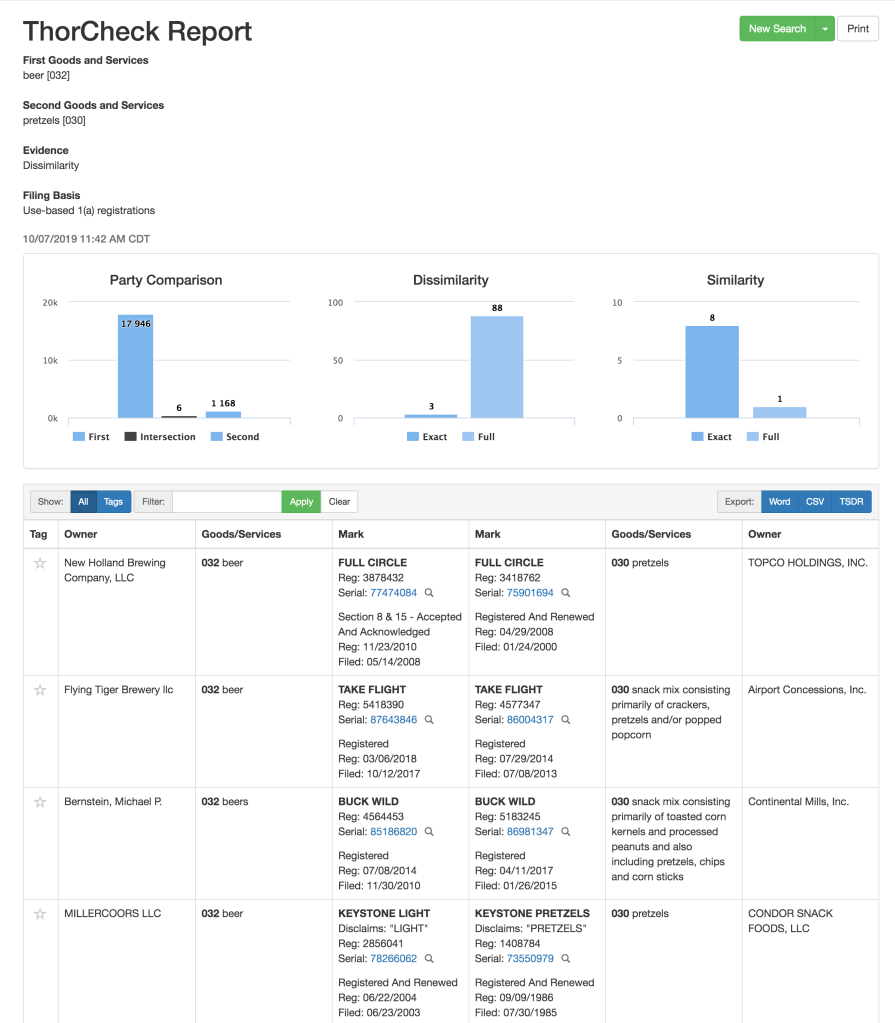
You may have noticed that ThorCheck reports now include visualizations of the search data.
What are the numbers?
There are three graphs. The first has raw counts on how common the two sets of goods (beer vs. pretzels) are, and how much overlap they had (both sets of goods in a single registration). The second gives you counts of how many identical and highly similar marks with different owners there are, and the third gives you counts of how many identical and highly similar marks with the same owners there are, whether in a single registration certificate or different certificates.
How can you use the numbers?
The charts give you a high-level view of the extent of overlap (or lack thereof) between two sets of marks or two sets of goods or services. You can do a quick look to see if you have a reasonable set of arguments, or if the arguments you want to make are outweighed by the .
The table below the graphical analysis section contains all the comparative research examples that you’ve come to expect. In the screenshot below, you’ll see the first three marks are identical, matching the “3” as “Exact” in the “Dissimilarity” section, and then the similar-but-not-identical mark comparisons start, like KEYSTONE LIGHT (disclaiming “light”) vs KEYSTONE PRETZELS (disclaiming “pretzels”). These are the examples that you will use to support your arguments, and the evidence you will provide your Examiner or the Board.
By mixing the context that the charts provide with the anecdotal evidence from the table, you can build your strongest Office Action Response or dispute arguments, and help your clients succeed.
Class-Based and Keyword-Driven Comparative Research
ThorCheck is a great, unique tool for comparative research.
The first iteration, and still the most commonly-used, helps you identify
active, use-based registrations for the same mark for two different sets of
goods, e.g. trailers and trucks. In re
Thor Tech, Inc., 113 USPQ2d 1546 (TTAB 2015). It saves hours or even days
of manual research, and has helped hundreds of applicants prevail over
difficult related-goods refusals.
The original ThorCheck Goods and Services tool is still your
best option for most goods/services comparative research, but was less adept at
two kinds of searching.
The first was for class based comparisons – finding overlap between, say, a food in Class 29 or beverage in Class 32 and a restaurant service in Class 43, or between a pharmaceutical in Class 10 and a medical service provider in Class 44. Any evidence of that type of overlap is potentially valuable, and ThorCheck’s emphasis on individual goods or services didn’t allow for easy “general” comparisons like this.
The second was for highly varied goods and services, like software – give the same description of a hospital-focused SAAS to ten different trademark lawyers, you’ll get ten different descriptions of services.
The new Custom option solves both sets of problems.
Class-Based Comparisons
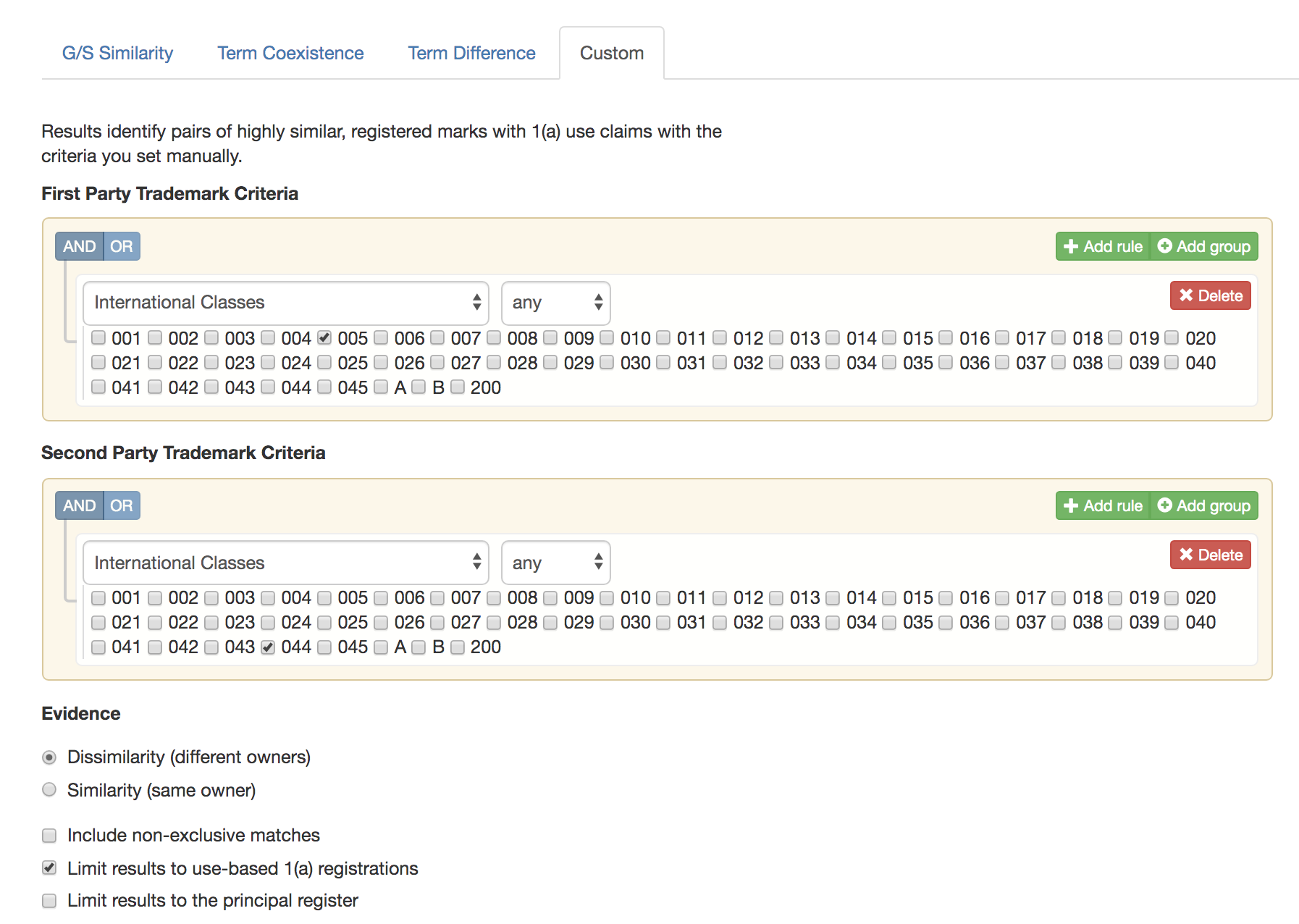
Setting up a custom search is easy – just pick one class in
First Party Trademark Criteria and the other in Second Party Trademark
Criteria. As always with ThorCheck, your results are limited to active,
use-based registrations.
Exporting a summary chart and TSDR status and title copies
is as easy as always; just tag relevant results and export to Word or Excel, or
select up to 100 records to get TSDR status and title copies at a go.
What if you’re the senior party, and want evidence that
cosmetics are related to more industrial chemicals? Just pick Class 1 and 3
respectively, and change the Evidence option to “Similarity,” as shown below.
Keyword-Driven Goods and Services Comparisons
Custom goods and services ThorCheck search strategies look a little more complicated, but they are conceptually simple: come up with two sets of search strategies that identify either different (Dissimilarity option) or overlapping (Similarity option) universes of marks. ThorCheck will put all the pieces together, lining up identical marks with either different owners (Dissimilarity option) or identical owners (Similarity option).
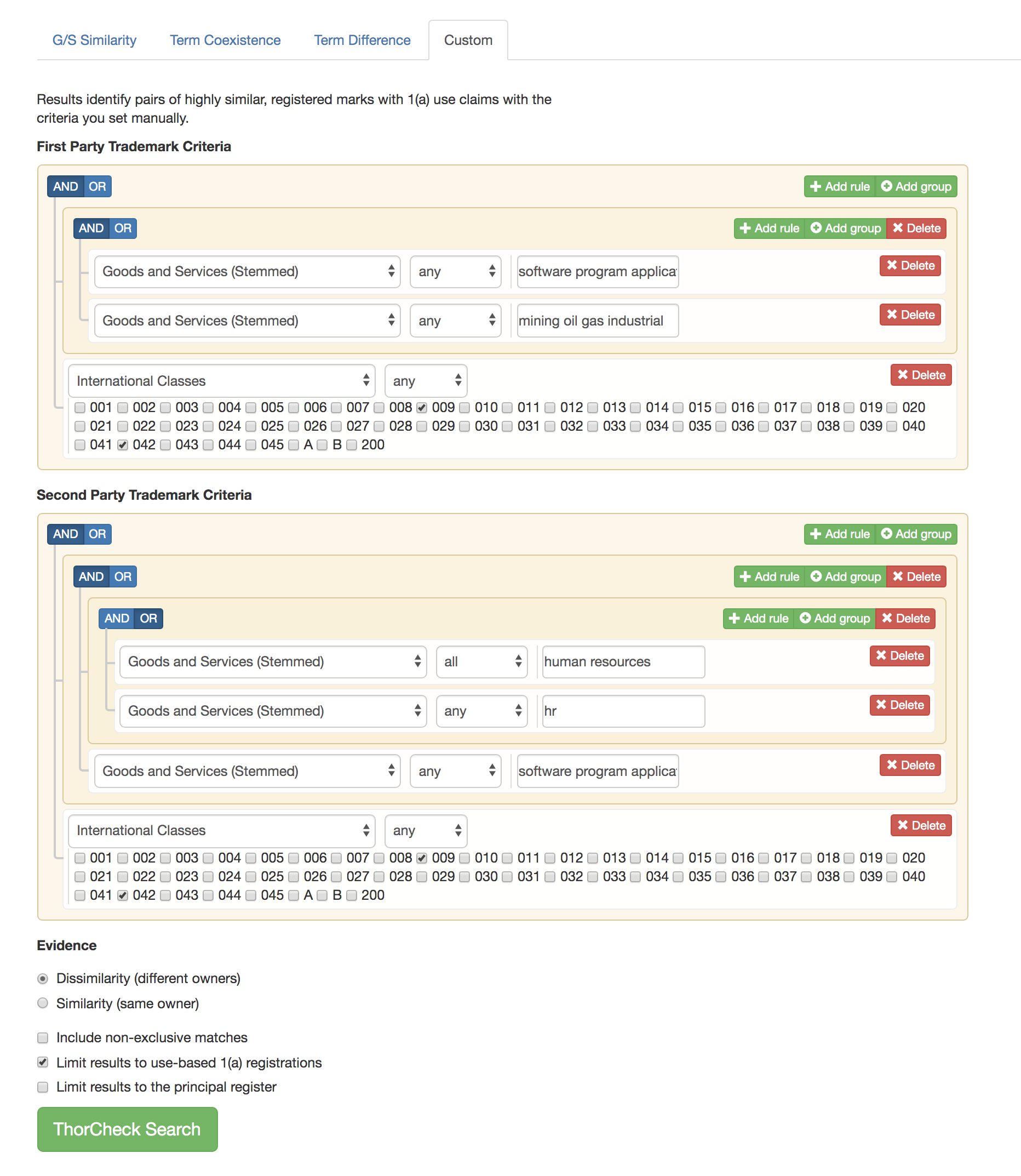
Let’s do an example. Say your client offers industrial software for running oil, gas, and mining operations. A prior registration for software in the HR space has been cited as a bar to registration, with the Examining Attorney taking the position that part of running industrial operations is dealing with HR issues. You plan to argue channels of trade and that the users of the software are different, but would love to have evidence to attack the relatedness of the goods directly. ThorCheck can provide it. We want to limit both First Party and Second Party criteria to Class 9 and 42. On the First Party Criteria, we want to pair software-related keywords with keywords like mining, oil, gas, and industrial. One the Second Party Criteria, we want to pair those same software keywords with either the phrase “human resources” or the term “HR.” The search strategy looks like this:
The results speak for themselves – dozens of examples of just this sort of overlap. A sampling of the representative results are attached, and it’s only a fraction of the evidence surfaced by ThorCheck. (The Word formatting doesn’t carry over to the blog great, so some details have been truncated for readability.)
Owner
Goods/Services
Mark
Mark
Goods/Services
Owner
Illinois Tool Works Inc.
009 business management software, namely, project management software for truss fabrication projects in the business component industry
HOMEBASE Reg: 2803070
HOMEBASE Reg: 4694369
009 042 software for human resources and labor management for employee communications, scheduling, task management, payroll, hiring, accounting, alerts, messaging, compliance, timesheets, reviews and feedback (…)
Pioneer Works, Inc.
Epicor Software Corporation
009 computer software for use in the made-to-order or custom manufacturing industry (…)
VISTA Reg: 2895370
VISTA Reg: 5387674
009 computer software for use in human resource management, in maintaining personnel and benefits records, and in processing payrolls
Personnel Data Systems, Inc. DBA PDS
Rosemount Inc.
037 042 technical support services, namely, troubleshooting of industrial process control computer software problems; installation of computer software for industrial process control systems
SMARTSTART Reg: 3544081
SMARTSTART Reg: 4969661
038 042 (…) application service provider (…) in the fields of (…) human resources, (…)
Smartstory Technologies, Inc.
TSI Incorporated
009 computer interface units and computer programs for use with gas or liquid flow measurement apparatus (…)
TSI Reg: 3651680
TSI Reg: 4096817
009 041 educational computer programs (…) used to teach persons (…) human resources (…)
NACD, LLC
Advanced Digital Data, Inc.
009 business management software that allows customers (…) to check their account status (…) in the petroleum products industry
SMARTCONNECT Reg: 3124058
SMARTCONNECT Reg: 5770389
042 provision of cloud computing (…) services (…) in the fields of payroll, tax, compliance, human resources (…)
ADP, LLC
Carrier Logistics Inc.
009 computer software for freight management in the transportation industry
FACTS Reg: 3074116
FACTS Reg: 5645276
042 (…) on-line non-downloadable software that allows consumers to manage human resources information, (…)
Criterion Inc.
Please enjoy our new class-based and keyword-based research options in ThorCheck, and keep the success stories coming! We love to hear how ThorCheck has helped your practice. Also, please tell your fellow trademark attorneys – word of mouth recommendations mean a lot to us.
TM TKO has full, searchable prosecution histories as a part
of the research platform, so I searched for any Office Actions related to this
type of refusal. Although the Examination Guide is new, the refusal is not – it
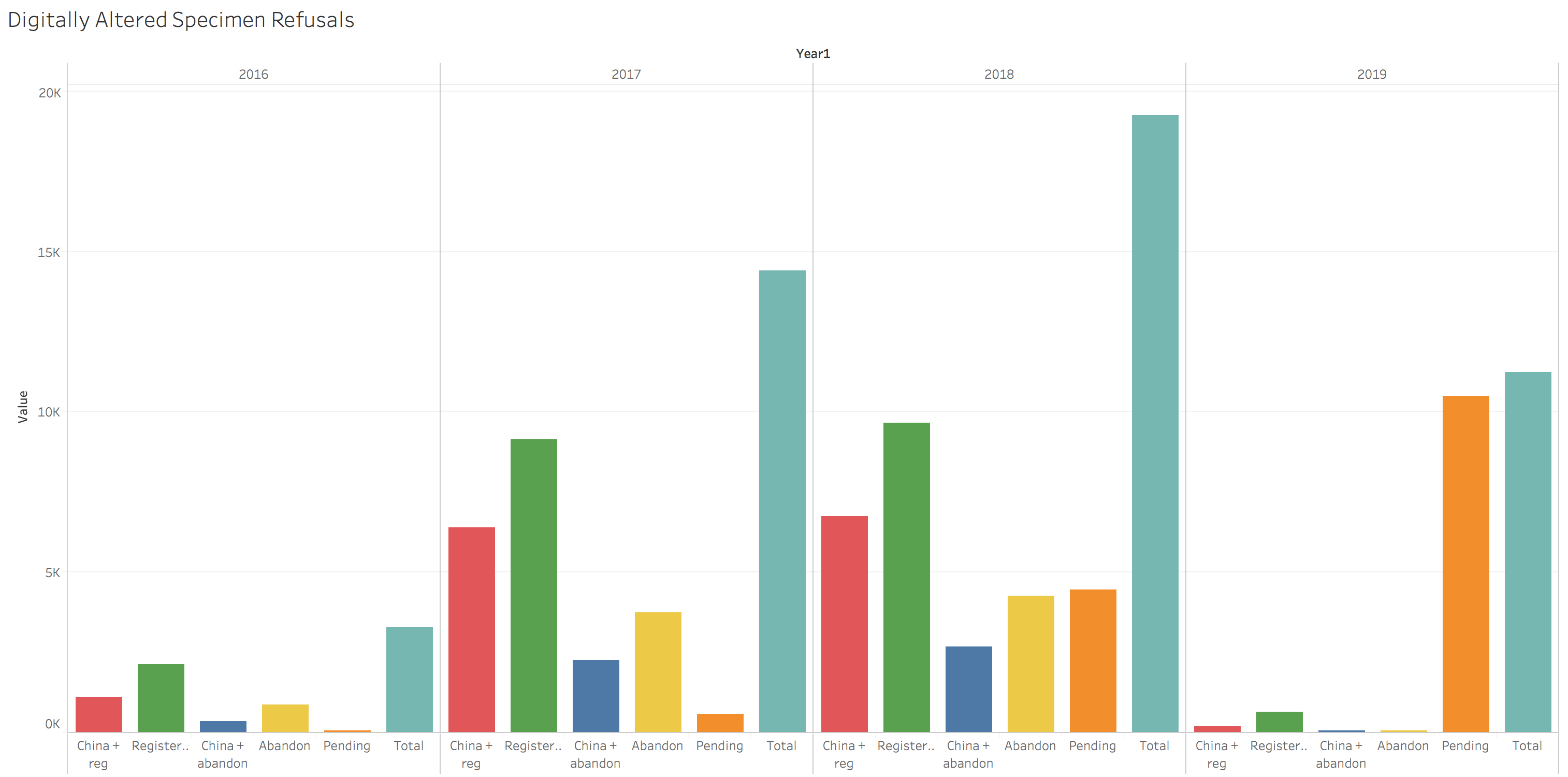
really started appearing in 2015, when the refusal was made about 1,000 times,
and the refusal rates has continued to spike in each year since; 2019 is on
pace for over 20,000 refusals. Since 2016, more than half of these refusals
have been issued to Chinese applicants. However, a surprisingly small number of
refusals have, to date, “held up” and resulted in the abandonment of the
application – about 70% of the applications that have been finally disposed of
have moved forward to registration, a far higher figure that I would have
expected.
This raises interesting questions about what sort of conduct
should result in an application being invalid. The “fraud” line of cases, like Medinol
Ltd. v. Neuro Vasx Inc., 67 USPQ2d 1205 (TTAB 2003), was killed extremely
dead via Bose Corp. v. Hexawave, Inc.,
88 USPQ2d 1332 (TTAB 2007). The Board has, as a result, been very unwilling to
expand revisit the idea of “fraud,” even where the applicant provided a
demonstrably false specimen – deceptive intent is required, and so long as the
applicant doesn’t say they had
deceptive intent, they’re pretty much going to get off the hook. Tommie
Copper IP, Inc. v. Gcool-Tech Usa LLC, Opposition No. 91223768
(May 9, 2018) [not precedential]. That a use-based application might be void ab initio due to non-use as of the use
date claim might still be tenable, e.g.,
Parametric Technology Corporation v. PLMIC, LLC, Opposition No. 91174641
and PLMIC, LLC v. Parametric Technology Corporation, Opposition No.
91177168 (February 12, 2010) [not precedential], but the case law seems pretty
clear that an applicant that knowingly submits
a fake specimen and then cures with a real one prior to registration is
basically going to be fine.
On the one hand, if the applicant ultimately can show that it is making real,
in-commerce use of the mark, where’s the harm? The applicant got it right
eventually and, for the purposes of having a registry that reflects reality,
well, it does. On the other hand, there’s some real skepticism in the practice
community that the specimens that are eventually accepted are actually real – that, instead, they’re just better fakes. Why would you fake
something if you have a real product or service, after all?
Some practitioners take the position that the verified
statement of the applicant should be taken at face value. I do not agree. If a
simple Google Images or Tineye search can find the original photo that was
doctored to match, or it’s otherwise equally blatant (a McDonald’s restaurant
photo with “Mary’s Burgers” badly edited in place of “McDonald’s”), I see no
reason why the USPTO should have to turn off its brain when examining specimens
and ignore obvious fakes.
Represented vs.
Unrepresented Applicants
How does being represented by an attorney impact the rate at
which these refusals are issued, and the how does it impact the rates at which
the refusals are overcome? The data for these queries treats pro se applicants who later add an
attorney as “represented.”
Chinese Applicants
It is widely understood in the trademark practitioner
community that a significant driver of these refusals are applications with
Chinese applicants. That is definitely true – 45% or more of these refusals
each year since 2016 are for Chinese applicants. Chinese applicants as a group
overcome these refusals at a rate that is better than the norm. Chinese
applicants have better success rates than unrepresented parties, although less
than all represented parties do.
The issue of digitally altered specimens will undoubtedly
continue to grow over time, as the technology becomes ever more omnipresent and
the USPTO continues to work to implement its new Examination Guide. As always,
TM TKO will be your best resource to research how the Office and other lawyers
are addressing these kinds of refusals.
TM TKO is excited to release a new concept – Portfolios. You can set up Portfolios for your firm, yourself, and key clients’ competitors, with built-in conflict checking and automated watch setup. Watch includes published applications, 2(d) cite watching, and more, helping you protect your existing clients and generate complex, high-value work for your practice.
Setting up a Portfolio takes under a minute – just go to the Portfolio page! For instructions, go to the Portfolio help page.
Firm & Competitor Conflicts
Track your entire firm’s trademark portfolio, to help identify representational conflicts in clearance searches.
Set up portfolios for your key clients’ main competitors, so those results are highlighted in your clearance results.
Hassle-free Watching
Set up an attorney portfolio, and TM TKO will keep your watches updated for you as your client base changes – no effort required. If you are only watching a small fraction of your client’s marks, you are missing out on dozens of opportunities each year to protect your clients and generate more, high-value billable work for your practice.
Included:
confusingly similar new applications;
confusingly similar applications newly published for opposition;
2(d) citations of your clients’ marks against other applications;
marks published over a 2(d) cite to a client mark;
With Portfolios from TM TKO, you can do a better job avoiding conflicts, highlighting competitive risks, and protecting and developing more work from your existing clients. If you would like a hand setting up or using the full power of Portfolios, just email us at support@tmtko.com and we will set up a web meeting.
The US Supreme Court has, as you’ve doubtless read a million
articles about already, struck down the Section 2(a) bar on registration of
“immoral [] or scandalous matter.” Iancu
v. Brunetti, ___ U.S. ___
(2019). It was no surprise to anyone who had read Matal v. Tam, the 2018 decision finding the 2(a) bar on disparaging
matter to be unconstitutional. 582 U.S. ___
(2017).
This blog post will take a more practical look at what
applications will be impacted, using TM TKO’s searchable issue tagging.
More than five hundred applications that are currently suspended based awaiting issuance of the Brunetti decision. The following numbers show the common terms that have resulted in suspensions, and include more easily-searched spelling variations.
Fuck and variants – 173
Shit and variants – 59
Breast-related – 16
Penis-related – 71
Vagina-related – 36
Butt-related – 17
Quite a few more related to specific sex acts, although
there’s too much variation for easy enough searching for the purposes of this
blog post.
A bit under half of the suspended applications do not have
counsel; those applicants represented by counsel were somewhat more likely than
the unrepresented applicants were more likely to have multiple applications
suspended awaiting the Brunetti
decision.
There does not appear to have been a land rush to file new
applications for offensive – yet. Application data can take a few days to a
week to filter into the USPTO data set, so it’s possible that there has in fact
been a profane land rush that will become apparent over the next few days.
Trademark filings can be an interesting lens to look at an entire industry. Today, we’ll look at real estate. It had a huge rise in the 2000s as housing prices boomed, then the subprime mortgage crisis hit the industry hard from 2007 – 2010.
Trademark filing trends track the rise, fall, and slow return of the industry surprisingly well. I looked at 4 main classes – Class 9 (apps), 35 (), 36 (), and 42 (hosted software). Filing trends for each largely match up, although Class 36 is both the most common class for applications and has seen the most proportionate growth in the post-2013 rebound.
The filing uptick before 2007 is clear, and followed by the sharp, recession-induced tail that we would expect. Filings were static though 2013, and started to rebound. Class 9 and 42 (apps and websites) are the least common, which may make sense given the additional technological investment required. Class 35 (real estate sales and marketing services) were more common, and Class 36 (listing and brokerage services) by far the most.
It’s not quite clear why Class 36 applications have spiked more than other classes over the last three years. I suspected that it might be a rise in foreign applicants, especially from China, but that is not a meaningful factor.
It is interesting that trademark filings have jumped more than actual US home sales – sales dropped from more than 7 million in 2005 to a low of 4.1 million in 2008 and 2010; sales have only rebounded to around 5.5 million per year in 2017-2018.
With HBO’s hit adaptation of George R.R. Martin’s A Song
of Fire and Ice drawing to a close, Game of Thrones has
a trademark portfolio and enforcement budget to match its cultural status.
Trademark Portfolio
We’ll just look at HBO’s US portfolio, headed by in-house
counsel Judy McCool.
At the time of writing, HBO has just over four hundred and fifty active
applications and registrations in its entire portfolio, and more than seventy
relate to Game of Thrones – about 15%
of HBO’s entire US portfolio.
The title Game of Thrones
or variations account for just over half of the total filings, and cover
everything from DVDs to spinoff games to slot machines, clothing, action
figures, watches, food and booze, and even swords. The rest of the filings are
scattered between character-specific marks like KHALEESHI for makeup and HODOR
for clothing to plot-driven marks like THE LONG NIGHT and WINTER is coming.
There are also a handful of more random filings like HAND OF THE QUEEN for
alcoholic beverages and clearly the strangest, MILK OF THE POPPY for clothing
and mugs (!).
Enforcement Efforts at the TTAB
HBO’s Trademark Trial and Appeal Board enforcement team, led by Tamara Carmichael
of Olshan, also has its hands
full. It has taken extensions of time to oppose or opposed dozens of
applications by third parties, most related to the Game of Thrones title itself.
7 ongoing extensions
15 withdrawn applications
10 defaults after opposition (most were unrepresented foreign applicants)
1 registration cancelled
2 amended applications
2 did not oppose
Three of HBO’s applications were also opposed or subject to
extensions; filings for GAME OF THRONES went through to registration, while HBO
dropped applications for DROGON and THREE EYED RAVEN for alcoholic beverages.
You represent a client with a successful new Spanish-style restaurant chain, called “Saffron.” You helped file a trademark application for the mark for restaurant services, and the Examining Attorney issued a 2(e)(1) refusal, noting that saffron is an ingredient in some of the dishes served at the restaurant and concluding that it is thus merely descriptive of the restaurant services. How do you push back?
One great way is to look at the responses of other applicants who dealt with very similar objections, and successfully overcame them. Go to “Search” and then the “Office Action” tab. We’re looking for active registrations in Class 43 on the Principal Register that faced a 2(e)(1) refusal where the Examiner focused on the “ingredient” issue. Your search will look something like the strategy below:
The search yields over 600 relevant documents; on the first page of results alone, we have registrations like RED CHERRY, YUZU SUSHI, LA TAGLIATELLA, PICKLED LEMON, RED MANGO, MARGARITA COMPANY, and more; the second page yields more great examples like AOILI (stylized), BLACK GARLIC, FILINI, BONE & BROTH, and more.
We searched for outgoing Office Actions to hone in on the Examiner’s concerns, but finding relevant responses is simply. Click “Documents” to get a full list of TSDR history, and just click into the next Office Action Response to see how the applicant addressed the issue.
If you find a good example you like, click the magnifying glass and select the “Text” option – you can copy and paste plain text from this document to get your own arguments started.
The next time you face an Office Action with a unique fact pattern, make sure to use TM TKO to kick start your research to find and build on proven successful responses!
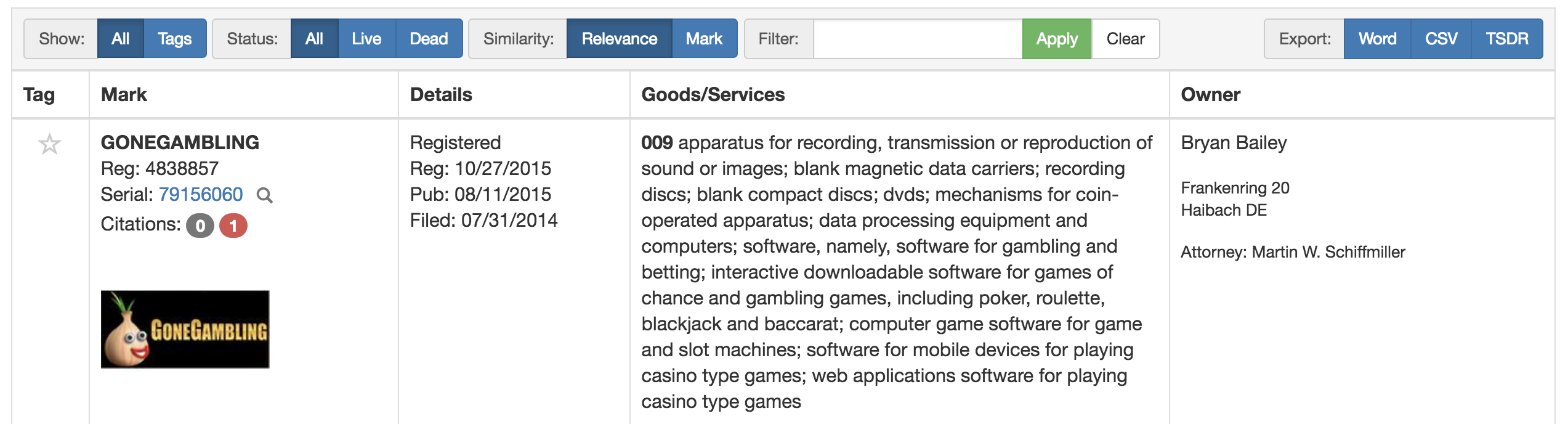
TM TKO has now incorporated visual indicators of citations in knockout search and manual search results. There is a gray circle for any citations “inbound” during prosecution, and there is a red circle for any “outbound” citations against other applications. You can click on either circle to see full details on the cited marks, to hop into their file histories, and more. This data is also available via the magnifying glass.
Visibility into cited records adds considerable depth to the search report. Knowing how frequently the USPTO is citing this application as a bar to other applications helps you more accurately judge the risk that filing might pose to your client’s mark, and secure better outcomes for your client with less research time.




 TM TKO Blog