Category Archives: Uncategorized

Pharma? Class 5 filings in 1Q 2017

International Class 5, which includes pharmaceuticals, is one of the most active classes for trademark applications at the USPTO. This blog post looks at some interesting Class 5 filing trends (and interesting marks) for applications filed in the first quarter of 2017.

The Most Common Class 5 Products

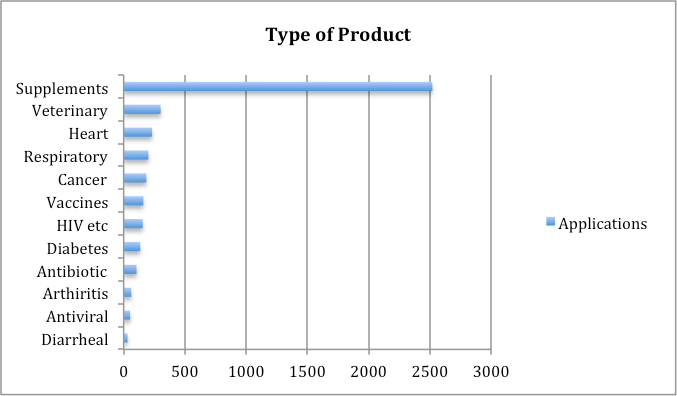
What types of products are applicants filing for? Most applications appear to be for easy-to-produce, lightly-regulated products like supplements and vitamins. It makes sense that there would be more of these than development-intensive, highly regulated pharmaceuticals, but the degree to which applications for these goods predominated was surprising.

Pharma_goods_spring_2017

How are Applicants Filing?

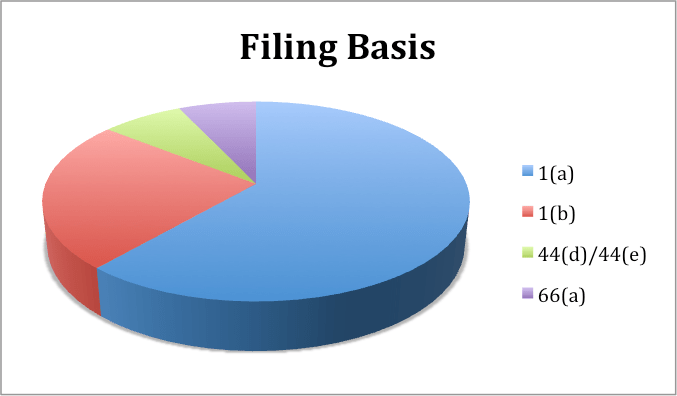
Most applications are filed based on actual use, followed by intent-to-use claims. Foreign priority or registration claims and Madrid Protocol applications lagged well behind.

Pharma_basis_spring_2017

Where are Applicants Located?

Together, applications from twenty of the largest foreign filers of Class 5 applications amounted to only about 800 applications, or about 16% of all 2017 applications in Class 5. Canada and Switzerland led the way, with China, Japan, Germany, and the UK well ahead of the rest of the pack.

Pharma_foreign_spring_2017

Some Fun Brand Names

Finding good pharmaceutical trademarks is tough work. There are a slew of pending applications and registrations, so clearance is tough, FDA name approval can be difficult, and marketing groups are torn between more suggestive names and completely coined marks. Here are a few of them we enjoyed.

Mark Comments
SLNDR Lose weight by removing vowels!
DANOCRINE Too remote for an effective demonstration
PUMP DIRT Checking the ingredient list…
SEXWAX !
OREGANOL

PROMATO

Combine for health-food lasagna?
DIAMOND FRESH As fresh as a billion year old chunk of carbon.
DRDOSE How is there not a rapper named this, you say? There is.
CRYPTOMUNE This will heal your animal, but if we tell you how, we’ll have to kill you.
NITRO BEETS I like this one.
GUT INSTINCT This too.
SAEF And effictive


Update: Losses in UDRP Complaints in 1Q 2017

Our last blog post on the UDRP, breaking down losses in 2016, was quite popular, so we’re doing an update for cases in the first quarter of 2017.

Data set

The data was manually coded from the National Arbitration Forum (“NAF”) searchable case database with decision dates from January to March 2017. Our previous research found similar outcomes for World Intellectual Property Organization (“WIPO”) proceedings, so this update focuses solely on NAF decisions.

Outcome Cases Percentage
Cancellation 0 0%
Transfer 342 92.7%
Denied 27 7.3%
Total 369 100%

Trends

We analyzed each victory for a respondent based on the grounds cited by the UDRP panel. Many decisions had more than one ground cited, so the total count of issues exceeded the raw number of decisions. One decision was not available online, and so counts as a denial but does not have grounds coded.

UDRP 1Q 2017

As in 2016, far and away the two most common causes of complainant’s losses were a failure to show any trademark rights that predated the domain name registration date (40.1% of decisions) or a failure to adequately demonstrate any trademark rights at all, particularly where the applicant claimed common-law rights (often in a fairly descriptive mark) without significant evidence of sales and advertising (14.9% of decisions).

One decision in particular was interesting: Wendy Murdoch, LLC v. Romero, FA 1706433 (Nat. Arb. Forum Jan. 13, 2017) (declining to transfer effortlessrider.com). The complainant had a trademark registration for the mark EFFORTLESS RIDER predating the domain name registration date, and used the domain name for competitive horseback-riding services, using the complainant’s mark prominently on the website. The panel had no problem finding that the domain name was confusingly similar to the mark nor that the use was a bad faith attempt to “create confusion for commercial gain,” but found that the respondent’s conducting business under EFFORTLESS RIDER – the complainant’s mark – insulated it under the “rights or legitimate interests” tab since the respondent was a “real business which offers real services” with an LLC of the same name (albeit created after the domain name was registered) and so was “commonly known by the at-issue domain name.”

This is a fairly perverse result. Under the logic, a seller of counterfeit Nike products that brands its entire site NIKE at the domain name nikeshoes4u.com would be immune to a UDRP, while a seller of counterfeit Nike products at a site titled SHOES at the domain name nikeshoes4u.com would, and so would a page of ads for NIKE knockoffs at the same domain. The first example is engaging in more conduct that the panel found to be bad faith, and which is explicitly conduct “for the purpose of disrupting the business of a competitor,” UDRP Par. 4(b)(iii), yet somehow creates a “right or legitimate interest.” Most panel decisions deal with the issue by noting that the domain registrant that uses “the domain name (and Complainant’s mark) to sell products in competition with Complainant demonstrates neither a bona fide offering of goods or services nor a legitimate noncommercial or fair use of the name.” Ultimate Elecs., Inc. v. Nichols, FA 195683 (Nat. Arb. Forum Oct. 27, 2003). The “commonly known as” exception usually to domain owners who use the domain for goods or services that are unrelated to the goods and services provided under the trademark owner’s prior mark. The Wendy Murdoch decision appears to be incorrect, and, if the line of reasoning spreads, potentially problematic for complainants, who will need to use the ACPA or another slower, more expensive enforcement option.

The Red Cross and Video Games

The Red Cross, Red Crescent, and Red Crystal symbols of the International Committee of the Red Cross are protected by the First, Third, and Fourth Geneva Conventions and several protocols thereto.

The Red Cross and Red Crescent emblems are intended to “provide protection for military medical services and relief workers in armed conflicts.”[1]

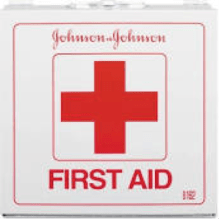
The United States implements this portion of the Geneva Conventions and Protocols via standalone legislation. The American Red Cross was protected via the Charter Act, passed in 1900 and available, as amended in 2007, at 18 U.S.C. §§ 706 – 706a., which gave it an exclusive right to use a red, Greek cross on a white field but grandfathered prior users, most prominently Johnson & Johnson on its first aid packs.[2]

JJ_aid

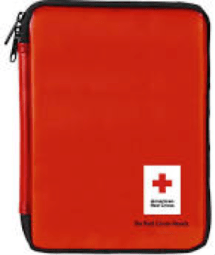
J&J actually filed a trademark infringement lawsuit against the American Red Cross when the ARC licensed use of the Red Cross emblem to several first aid and disaster preparedness kit manufacturers; the ARC prevailed on a key motion and the parties settled out all remaining issues.[3] They apparently now co-exist without issue.

arc_aid

Unlike typical trademark laws, the Charter Act does not look at whether the use makes consumer confusion likely: it simply bars any use other than by the American Red Cross (or, after the 2007 amendments, the ICRC and other national societies and their agents), with misdemeanor penalties including imprisonment available as remedies.[4]

The ICRC and its local affiliates seem to have taken a more aggressive approach recently to enforcement of these rights in the context of video games.[5] The Canadian Red Cross defended more aggressive enforcement efforts in a blog post arguing that “[m]isuse of this valued symbol distorts its meaning and its protective value for victims of conflict and the aid workers that assist them.”[6] This is essentially a dilution argument – even if no real-world confusion results, the distinctiveness of the symbol will be reduced, reducing the efficacy of the protection the Geneva symbols provide to relief personnel in the real world.

Games have tended to the Geneva symbols in one of two ways: to suggest “health,” and to refer to the Geneva symbols themselves. The first type of use is quite common; from the earliest first-person shooters, health packs often included red crosses to suggest first aid kits. An example from an early version of the game Doom is shown below.

doom

Other video games take a more realistic approach, trying to simulate war. The use of the Red Cross symbol in this sort of game, to depict the actual Red Cross in the game, is an expressive use and, in key circuit courts, it is analyzed under the Rogers v. Grimaldi test: use of a trademark in an expressive work is only infringing if “(1) the use of the mark has no artistic relevance to the underlying work whatsoever, or (2) it has some artistic relevance, but explicitly misleads as to the source or the content of the work.” In the context of the military game Call of Duty, a California court held that use of a military equipment company’s marks in-game received full protection under the First Amendment. Mil-Spec Monkey, Inc. v. Activision Blizzard, Inc., 74 F.Supp.3d 1134 (N.D. Cal. Nov. 24, 2014). There is a strong argument that, under traditional confusion or dilution analysis, this sort of in-game use would also be permissible.

Because the Red Cross symbol is not protected via traditional trademark laws, third-party use of the Red Cross symbol does not require the same test; neither confusion nor dilution are required, and the rights granted under the Act are ironclad as to junior users.

This “right” presumably is not absolute, no matter what the statute says; it’s almost impossible to envision a court granting relief to the Red Cross against a newspaper that runs a picture of the symbol or that uses the words “Red Cross” in connection with an investigative report, for example. The First Amendment concerns underlying Rogers are, in theory, no less important, though it seems unlikely that a court interpreting the Charter Act would treat them identically. How treaties and the protections of the Bill of Rights interact with each other is way beyond the scope of this little blog post, but the general understanding is that the individual protections of the Bill of Rights are retained without regard to other treaty obligations.[7]

Video game makers have certainly erred on the side of caution. In a March update, the multiplayer space simulator EVE Online updated the icon for a ship module to “comply with the Geneva Conventions,” presumably after a demand from the ICRC or a national affiliate.[8] The company is based in Iceland with operations in the UK and US, and may well have been subject to multiple legal regimes that may be less sensitive to concerns of the sort that impact US First Amendment decisions.

The old symbol: old_dc The new symbol: new_dc

The UK-designed indie game Prison Architect made similar changes, swapping red crosses on ambulances, shown below, for green.

Ambulance

Even the largest studios have been affected; in 2006, Microsoft’s Bungie updated its red-crossed health pack in its flagship Halo shooter for a red “H” symbol.[9]

Halo_packs

It will almost always be simpler for game designers to just push out a minor update to its graphics than to fight the issue in court, but the question is legally interesting and, if a large enough gaming company decides to push back, could make for some very interesting precedent.


[1] https://www.icrc.org/en/war-and-law/emblem

[2] See A. Barach, “One Cross – Two Cross – Red Cross – Blue Cross When Trademark and Health Care Collide” (Apr. 3, 2012), available at https://www.bradley.com/insights/publications/2012/04/one-cross–two-cross–red-cross–blue-cross-when__.

[3] Johnson & Johnson v. The American National Red Cross et al., Case No. 07-cv-07061 (S.D.N.Y. 2008) in the U.S. District Court for the Southern District of New York.

[4] Providing fines or imprisonment for anyone who “uses the emblem of the Greek red cross on a white ground, or any sign or insignia made or colored in imitation thereof or the words ‘Red Cross’ or ‘Geneva Cross’ or any combination of these words.” 18 U.S.C. § 706.

[5] ; https://www.youtube.com/watch?v=vOAq26xCefY&feature=youtu.be&t=6s provides a good, quick look at other examples.

[6] http://www.redcross.ca/about-us/about-the-canadian-red-cross/red-cross-emblem/it-may-just-be-a-game-to-you-but–it-means-the-world-to-us

[7] Compare Missouri v. Holland, 252 U.S. 416 (1920) with Reid v. Covert, 354 U.S. 1 (1957).

[8] https://community.eveonline.com/news/patch-notes/patch-notes-for-yc119.3-release.

[9] http://kotaku.com/video-games-arent-allowed-to-use-the-red-cross-symbol-1791265328.

PYROSIL – Anatomy of an Office Action Response #4

Anatomy of an Office Action Response

Episode 4 – PYROSIL

What is this series?

We break down a recently-filed, successful Office Action Response, looking at the case law, evidence, and strategic decisions that made it a success.

Today’s post focuses on strategies in responding to a likelihood of confusion refusal featuring identical marks in different classes.

The Office Action – PYROSIL

The applicant’s filing for PYROSIL, Ser. No. 86912816, for a variety of products and services including silicon and other chemical precursors (Class 1), fuel and dust absorbing and binding compounds (Class 4), metered fuel pumps (Class 9), and chemical coating services (Class 44), and actually used for a silicon oxide coating and coating process, received a citation to a prior pending application for PYROSIL for paints and primers used in the aerospace industry (Class 2), Ser. No. 79179408. Both applications are now registered.

Because the prior PYROSIL application was still pending, the Office Action did not provide (and did not need to provide) arguments to support the refusal.

The correspondent, Otto Lee of Intellectual Property Law Group LLP, filed an Office Action Response arguing against the refusal. The prior applications’ limitation to the aerospace industry was a key: it limited the customer base of the cited mark, and the applicant supplemented the meaning of “industrial” products in its description with extrinsic information about the product and its customers. The Response emphasized that the products offered under both marks were sold to different and non-overlapping classes of sophisticated customers in distinct manufacturing industries, and were necessarily sold through different trade channels. While the applicant’s products are focused on adhesive promotion coatings, e.g. to increase print quality, the applicant’s website references automotive uses and neither the description of goods in the application nor the supplementary materials carve out or disavow aerospace or military use. That’s certainly a desirable outcome for the applicant, and a good strategic reason for counsel relying on extrinsic evidence rather than narrowing the applicant’s description of goods to exclude the fields.

Counsel also pointed to another out-of-class registration for PYROSIL, Reg. No. 2546215, for thermocouples in Class 9, noting that it was also sold to a niche group of professional buyers and could co-exist without confusion. This data point is valuable under the 6th du Pont factor, and arguably also restricts the prior registrant’s rights under the 11th du Pont factor as well.

The response made a variety of arguments about the lack relationship between the goods, ultimately successfully. The applicant could have pointed to registry evidence of co-existence of similar products, both in industrial silicon and fuels. In re Thor Tech, Inc., 113 USPQ2d 1546 (TTAB 2015). The following table, from TM TKO’s ThorCheck prosecution tool, identifies a number of instances where identical or highly similar marks co-exist without apparent confusion for exactly the sorts of goods.

Owner Goods/Services Mark Mark Goods/Services Owner
Regal Chemical Company 001 silicone emulsions for control and suppression of foam in aqueous solutions REGAL
Reg: 3842060
Serial: 77461042
REGAL
Reg: 1706125
Serial: 74196056
002 interior paint Columbia Insurance Company
Dow Corning Corporation 001 polycrystalline silicon, polysilicon, silanes, and silicon source chemicals used in manufacturing silicone ingots and wafers for semiconductor devices (…) HSC
Reg: 3734230
Serial: 77761283
HSC
Reg: 3469539
Serial: 78818952
002 paints Superior Products International Ii, Inc.
Emerald Performance Materials, Llc 001 specialty and fine chemicals, resins and polymers, namely, (…) silicone-based additives in the nature of low molecular weight silicone-based oligomers, (…) all for use in the manufacture of (various products) EMERALD
Reg: 4344989
Serial: 85324867
EMERALD
Reg: 4686712
Serial: 85980802
002 paint thinners Emerald Services, Inc.
Petroleum Marketing Analysis, Inc., dba Aura Oil & Lamp Creations 004 lamp fuel AURA
Reg: 4007891
Serial: 77300540
AURA
Reg: 3220824
Serial: 78753154
002 exterior paint Columbia Insurance Company
Chevron Intellectual Property Llc 004 lubricating-oils REGAL
Reg: 0088032
Serial: 71058463
REGAL
Reg: 1706125
Serial: 74196056
002 interior paint Columbia Insurance Company
Champion Brands, LLC 004 stove and lantern fuel HI-TECH
Reg: 2256277
Serial: 75239061
HI-TECH
Reg: 1295391
Serial: 73404876
002 spray paint Seymour Of Sycamore Inc.
Tiara Brands, Inc. 004 gasoline CROWN
Reg: 2069133
Serial: 75081978
CROWN
Reg: 1334990
Serial: 73493222
002 paint thinner Packaging Service Co., Inc.
West Penn Oil Company, Inc. 004 gasoline EMBLEM
Reg: 0330234
Serial: 71367514
EMBLEM
Reg: 4732801
Serial: 86190094
002 paints The Valspar Corporation
Regal Beloit America, Inc. 004 lubricating oils and greases WAVERLY
Reg: 4489586
Serial: 85889529
WAVERLY
Reg: 2340120
Serial: 75541752
002 house paint Icon De Holdin GS Llc
Sterno Products, Llc 004 chafing dish fuel HOT SPOT
Reg: 4500511
Serial: 85835539
HOT SPOT
Reg: 1311806
Serial: 73403836
002 spray paint Seymour Of Sycamore Inc.
Charles Carney

dba Pro Tech Lubricants

004 diesel oil PROTECH
Reg: 4661852
Serial: 86043852
PRO TECH
Reg: 4847575
Serial: 86424118
002 architectural paints Swimc, Inc.
Micro Powders, Inc. 004 wax emulsions and wax powders for industrial applications AQUAMATTE
Reg: 4209568
Serial: 85540685
AQUA MATTE
Reg: 2091731
Serial: 74642767
002 interior paint Swimc, Inc.

Following the successful Office Action Response, the application will be published for opposition in March 2017.

Anatomy of an Office Action Response – #3

Episode 3 – Trowel Pro

What is this series?

We break down a recently-filed, successful Office Action Response, looking at the case law, evidence, and strategic decisions that made it a success.

Today’s post focuses on strategies in responding to requests for information under 37 C.F.R. § 2.61(b).

The Office Action – TROWEL PRO

Today, we are looking at a successful Office Action Response filed in the course of prosecuting an application to register the mark TROWEL PRO for a variety of construction materials in International Classes 1, 17, and 19, Ser. No. 86/885,391. The applicant, Laticrete International, Inc., is represented by Peter Peterson of DeLio, Paterson & Curcio, LLC.

The main issues raised by the USTPO Examining Attorney were (a) a disclaimer of “trowel” and (b) an information request about the meaning of “pro” in the industry.

Analyzing the Office Action

We will do a quick analysis of the Office Action through TM TKO’s tools. You can see an interactive version of this search report here.

The Office Action noted that trowels are frequently used with grout and other of the applicant’s goods. TROWEL is not especially common as a part of marks in related classes, but it shows up with some frequency in description of services and in disclaimers or in marks that are on the Supplemental Register. The applicant decided to accept the disclaimer request, and there was plenty of evidence to support that being the right call.

trowel_strength.png

The Examining Attorney also asked whether PRO has any meaning or significance in the industry and whether it is a “term of art” in the industry. These requests are often a prelude to a Section 2(e) refusal. PRO as a part of the mark grades out as even weaker, due to substantial dilution, so extra care was required in addressing the issue. If both parts of the mark are treated as non-distinctive, the mark as a whole is more likely to end up on the Supplemental Register, which provides substantially fewer rights than a registration on the Principal Register with all but one term disclaimed, even if the remaining term is not conceptually especially strong.

Care is required in these responses; the Office will routinely use responses in requests for information under 37 C.F.R. § 2.61(b) as the basis for refusal, see, e.g., In re FM Tech., Inc., Ser. No. 86100919 (TTAB Jul. 27, 2016) (upholding 2(e) refusal for 3DRad mark in part due to response to the respondent’s reply to an Examiner’s “function” question: “… by radiation with integrated imaging”), and incomplete or vague replies can be grounds for refusal, In re Cheezwhse.com, Inc., 85 USPQ2d 1917 (TTAB Feb. 1, 2008).

The Office Action Response

In the Office Action Response, the applicant disclaimed the term “trowel” and took a cautious response to the next two questions. The applicant simply noted that “pro” has no additional meaning or significance in applicant’s industry and is not a term of art in applicant’s industry. It’s an appropriate enough response in that “pro” doesn’t mean anything special in connection with these goods, although “pro” is generally used to indicate high-quality or “professional” quality goods (and is used, and disclaimed, as a part of competitive marks on the registry), and it looks like the Examining Attorney could easily have taken a harder line.

The applicant responded to the information request by noting that “there are no fact sheets, manuals or advertisements yet available” and replied very generally that the goods will be used in building construction in connection with installation of concrete, mortar, grout, etc.; the applicant did not provide equivalent material from competitors. The Examining Attorney could have taken the position that the amount of information provided was insufficient, but chose not to press the issue further.

TL;DR

When responding to a request for information, it’s vital to curate the information you provide. If the Examining Attorney needs more, the worst that can happen is that you will get a second Office Action or a Final Office Action, and in either event have a second opportunity to provide more.

Anatomy of an Office Action Response #2

Episode 2

What is this series?

We break down a recently-filed, successful Office Action Response, looking at the case law, evidence, and strategic decisions that made it a success.

The Office Action – PROT-LUNG

Today, we are looking at a successful Office Action Response filed in the course of prosecuting an application for PROT-LUNG for herbal supplements focused on lung health in International Class 5, Ser. No. 86/890,321. The applicant, Biocalth International, is represented by Thomas Rozsa of Rozsa Law Group.

The main issue raised by the USTPO Examining Attorney was a likelihood of confusion refusal under Section 2(d) of the Lanham Act with a prior registration for PROT BEAUTY for vitamins and food supplements, Reg. No. 4,254,836.

Analyzing the Office Action

We will do a quick analysis of the Office Action through TM TKO’s tools. You can see an interactive version of this search report here.

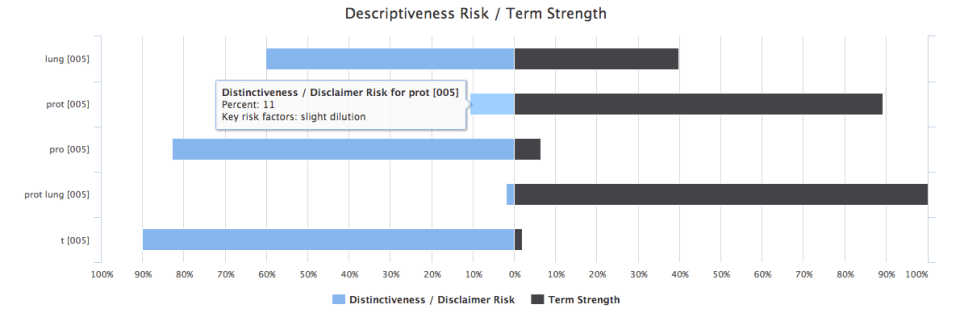
First, the strength of the term. PROT is the most distinctive portion of the mark – slightly diluted with third-party-owned marks, but not much; LUNG, unsurprisingly, grades out as even less distinctive.

prot_lung_strength.png

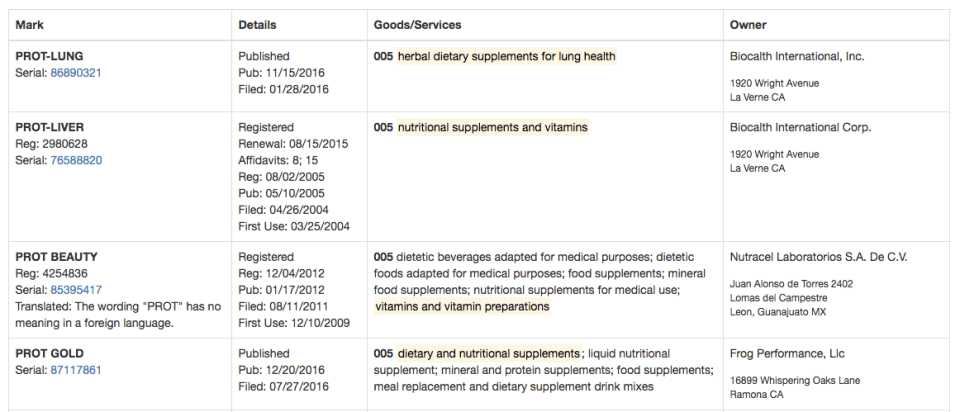
It’s no surprise, then, that the Examining Attorney focuses on the common term PROT in PROT-LUNG and PROT BEAUTY as potentially generating a likelihood of consumer confusion. Like the Examining Attorney, TM TKO’s report identified the three most-similar third-party marks as an incontestable registration for PROT-LIVER (owned by the applicant for similar goods), the cited PROT BEAUTY registration, and a later third-party filing for PROT GOLD for supplements as the most similar marks. The later-filed application would not have been relevant for examination purposes.

prot_lung_table.png

Plotting out mark similarity, with mark similarity on the vertical axis and goods/services similarity on the horizontal axis, the registration for PROT BEAUTY shows up as fairly similar, with the overall risk profile is comparable to two several similarly-situated marks, including the applicant’s own PROT-LIVER registration.

prot_lung_scatter.png

Note: common owners show up in the same color. The applicant for PROT-LUNG and the registrant for PROT-LIVER have small variations in their corporate names, so are not color-coded as having a common owner.

The Office Action Response

Biocalth’s response strategy began with that very PROT-LIVER registration, which was claimed as a prior registration from the initial application.

Biocalth noted, quite reasonably, that its PROT-LIVER registration issued before the PROT BEAUTY application was ever filed. If PROT-LIVER and PROT BEAUTY co-exist without confusion, and without intervention by the Office’s examination, there is no reason why PROT-LUNG and PROT BEAUTY shouldn’t do the same.

The Office Action Response simply argues the principle but does not point to any case law. Why not?

In general, the case law does not support the argument, even though it is intuitively powerful. The so-called Morehouse defense, based on Morehouse Mfg. Corp. v. J. Strickland and Co., 407 F.2d 881, 160 USPQ 715 (CCPA 1969), is perhaps the best-established line of cases acknowledging a similar argument. The Morehouse defense is available where the applicant owns an active registration on the Principal Register for essentially the same mark for the same goods. The marks in question do not need to be identical; they just need to contain the same portion of the mark for which confusion is asserted. See, e.g., The Place for Vision, Inc. v. Pearle Vision Center, Inc., 218 USPQ 1022, 1023 (TTAB 1983) (approving defense where the applicant sought to register “PEARLE VISION CENTER” and a design element for the same goods for which the applicant had a previous registration for “VISION CENTER,” since the alleged confusion related the “VISION CENTER” portion of applicant’s mark and not to “PEARLE” or to the design portions of the mark).

Unfortunately for our applicant here, and indeed for all applicants in ex parte examination, the Morehouse defense is just that – a defense, and an equitable one. Like all equitable defenses, such as laches and acquiescence, the Morehouse defense is only available against a party. There is no adverse party in an ex parte examination, and the defense is not available.

What can the applicant do? There are three approaches, each of which can be effective.

First, simply make the argument without citation. That lets you make the argument to the Examining Attorney, and point towards the fair result, without getting burdened in the case law. That was the approach adopted here, and it worked.

Second, the applicant can explain the most-nearly-applicable case, acknowledge that it isn’t controlling, but note that the doctrinal concerns behind the case’s holding apply with considerable strength to the present situation. It makes for a longer argument, but can be effective with Examining Attorneys who prefer a response grounded in the policy and principles underlying case law. The risk is that “explaining too much” may reduce the equitable punch of the argument.

Third, the applicant can argue that the prior registration is significant evidence under the catch-all thirteenth Du Pont factor. There is some good case law on supporting this approach, and it’s probably the author’s favorite of the three options. See In re Strategic Partners, Inc., 102 USPQ2d 1397 (TTAB 2012) (finding ANYWEAR (stylized) for footwear unlikely to be confused with a registration for ANYWEAR BY JOSIE NATORI & Design for “jackets, shirts, pants, stretch t-tops, and stoles,” largely because the applicant owned a prior, active registration for ANYWEARS for footwear).

What does the Office Action Response here do after leading with an un-cited Morehouse-style argument? It focuses on the differences between the marks, and on case law finding no confusion where the later-filed mark contains all or a part of a prior registered mark, if the marks as a whole differ, especially those where the common term was suggestive. This avoided a need to argue that the PROT portion of the mark was diluted or otherwise not conceptually strong, since doing so would potentially limit the applicant’s rights in both PROT-LUNG and PROT-LIVER in the future.

Together, the two types of arguments carried the day, and the application was published for opposition.

TL;DR

Limited or absent case law support does not mean that you cannot make an argument. If your argument makes doctrinal trademark sense and leads towards a fair (and favorable) result, make it anyway!

Brand Spotlight – Walmart

TM TKO Brand SpotlightEvery week, TM TKO will look at a major company and its trademark portfolio.

Company: Wal-Mart Stores, Inc.
Website: www.walmart.com
Twitter: @walmart
Headquarters: Bentonville, AR
2016 Fortune 500 rank: #1
Market capitalization: $208 billion
2015 Revenue: $482 billion
2015 Profit: $121 billion
Employees: 2.3 million
2016 Interbrand rank: n/a
US trademark registrations owned by Wal-Mart Stores, Inc.: 518

Original logo: walmart_old
Current logo: walmart_new

Company data – comparative analysis

Wal-Mart is the world’s largest retailer. Its 2015 revenues of $482b considerably exceeded the mean ($126b) and median ($81b) the Fortune 100 company in the retail sector (plus Amazon), and outpaced the Fortune 500 ($12b median) and Fortune 1000 ($7b median) by even more.

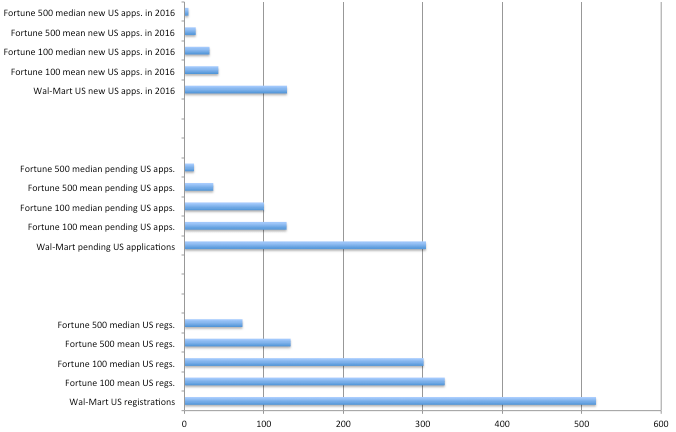
Trademark data – comparative analysis

Walmart has a very active trademark portfolio, with substantially more registrations and pending applications than its competitors in the Fortune 100 and 500 in the retail space. The analysis looks only at the companies that own the house brand of the entity; entities with numerous subsidiaries that own many brands will be comparatively under-counted.

walmart_numbers.png

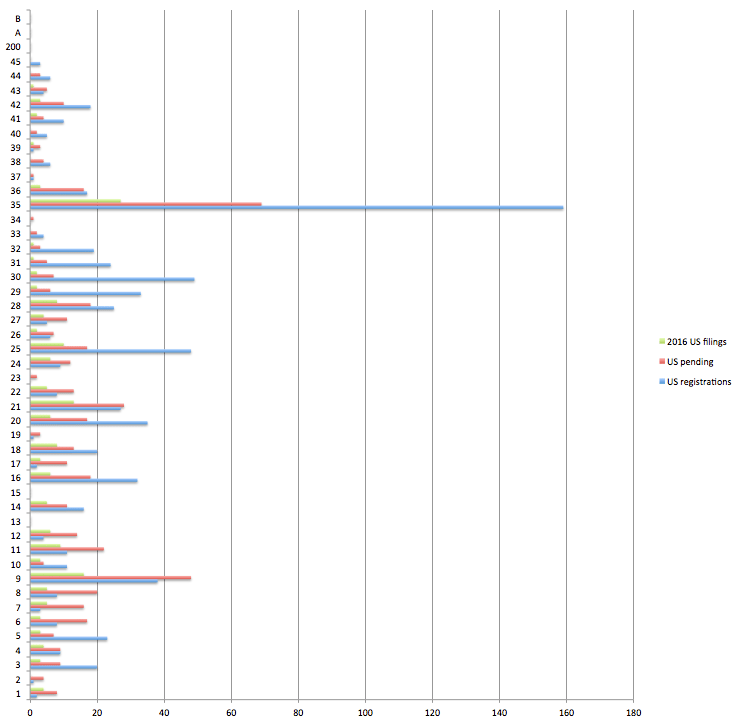
Breakdown of Walmart’s US trademark portfolio

Walmart owns one of the broadest trademark portfolios in the US, with registrations or pending applications in almost every international class. The bulk of its filings are concentrated in Class 35 (retail services), Class 25 (clothing), and Class 30 (food).

walmart_us_filings_analysis

Anatomy of an Office Action Response

anatomy_lesson

Rembrandt’s 1632 oil painting “The Anatomy Lesson of Dr. Nicolaes Tulp”

What is “Anatomy of an Office Action Response”?

We are starting a new series of blog posts called “Anatomy of an Office Action Response.” In this series, we will do a deep dive into a recently-filed, successful trademark Office Action Response: the mechanics of filing, strategic considerations, and the arguments that won the day.

The Office Action – PRIVACYCORE

Today, we are looking at a successful response to an Office Action for the mark PRIVACYCORE in the stylized format shown below, Ser. No. 86/922,696. The Examining Attorney viewed and initially searched the mark as EPRIVACYCORE; more on that later on.

Mark: privacycore

Register: Principal
Class 41 (original ID): Training services in the fields of privacy and data security; e-learning services, namely, providing online training courses and training materials in the fields of privacy and data security; providing an electronic library of training courses and training materials in the fields of privacy and data security for delivery by means of a learning management system (LMS)
Applicant: The International Association of Privacy Professionals, Inc.
Filed: Feb. 29, 2016.

In the initial Office Action, the US Patent & Trademark Office Examining Attorney preliminarily refused registration under Section 2(d) of the Lanham Act, 15 U.S.C. §1052(d), on the basis of a likelihood of confusion with Reg. No. 4,919,881.

Mark: EPRIVACY OFFICER (disclaims “officer”)
Register: Supplemental
Class 45: Consulting and legal services in the field of privacy and security laws, regulations, and requirements
Registrant: Nanette Awad
Filed: Jul. 29, 2015
Registered: Mar. 15, 2016 (Supp. Reg. date Jan. 10, 2016)

The Office Action focused on the relationship between the fields of use (training vs. consulting services in the same privacy and security fields) and the similar starts of the mark, EPRIVACY—.

The Office Action also noted a potential likelihood of confusion with two prior pending applications, Serial Nos. 79/177,839 (TRADECORE) and 86/683,357 (EPRIVACY HEALTH SOLUTIONS). Details for each follow:

Mark: EPRIVACY HEALTH SOLUTIONS
Register: Principal
Applicant: Nanette Awad
Filed: Jul. 5, 2015
Abandoned: May 24, 2016

Mark: TRADECORE
Register: Principal
Registrant: Onventis GmbH
Filed: Sep. 8, 2015
Reg.: Oct. 11, 2016
Class 9: Computer software for electronic data processing in the field of cloud-based procurement and electronic procurement processes
Class 35: Organisational business project management in the field of electronic data processing; updating and maintenance of data in computer databases
Class 38: Providing user access to global computer networks
Class 41: Arranging of seminars; conducting of seminars in the field of procurement processes, ecommerce, and supplier-relationship management; training services in the field of procurement processes, ecommerce, and supplier-relationship management
Class 42: (a long mix of data security focused software and services)

The Office also suggested some minor amendments to the descriptions of services. None of the changes were substantive nor affected the substantive portions of the response, and we will not focus on them for the rest of this post.

Analyzing the Office Action

We will do a quick analysis of the Office Action through the prism of TM TKO’s tools. You can see an interactive version of a search report for EPRIVACYCORE (searched with an initial “e,” as the Examining Attorney did) here.

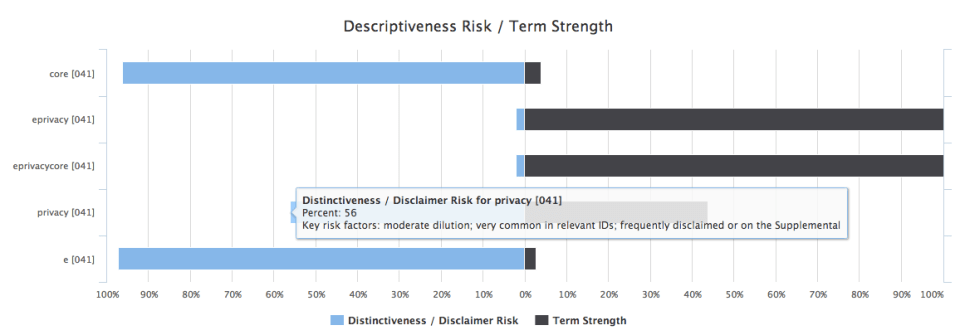
This bar graph shows how TM TKO divides up the mark (E – PRIVACY – CORE) and the relative distinctiveness of each of the terms in the mark (none very distinctive on their own). For example, “privacy” in Class 41 is commonly disclaimed and moderately diluted on the registry, and shows up frequently in relevant descriptions of services. The “e” prefix and “core” each also appear relatively weak.
eprivacycore_bar

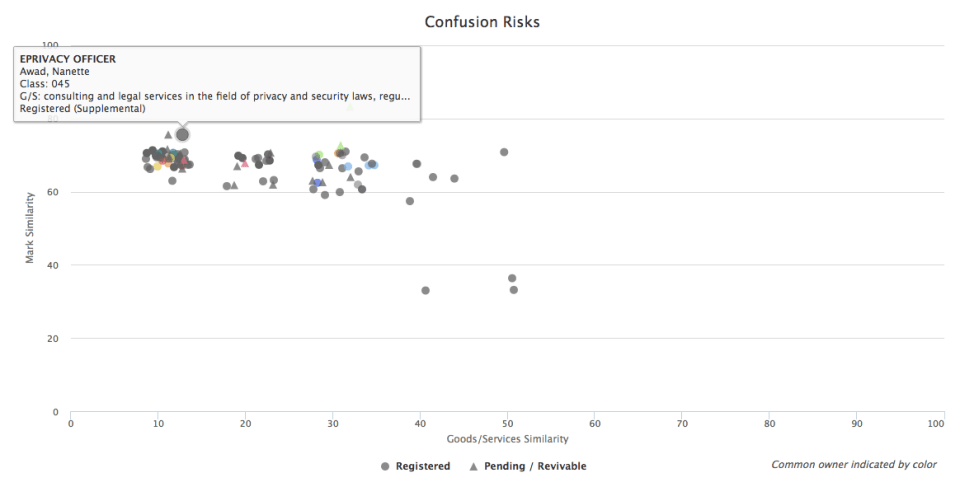
Plotting out mark similarity, with mark similarity on the vertical axis and goods/services similarity on the horizontal axis, the registration for EPRIVACY HEALTH SOLUTIONS scores out as the most similar mark, though it is out of class and on the Supplemental Register.
eprivacycore_scatter

The strategy for addressing both of the prior cited marks that had not gone abandoned at the time of the response seems pretty clear: argue that the differences between the marks outweigh the similarities, and that shared portions of the mark aren’t strongly source indicating by themselves, as in Citigroup Inc. v. Capital City Bank Group, Inc., 98 USPQ2d 1253, 1261 (Fed. Cir. 2011) (no confusion likely between CAPITAL CITY BANK and CITIBANK due to commonality of “City Bank” in the industry).

The Office Action Response

Counsel for the applicant, Wade Savoy of Patent GC, argued that confusion was unlikely to occur with either of the two still-active cited registrations.

For the EPRIVACY OFFICER citation, the applicant argued that the applied-for mark was in fact just PRIVACYCORE not EPRIVACYCORE, and that the initial design is abstract rather than a design of an “e.” The applicant pointed to its textual uses of PRIVACY CORE, where the mark did not include an “e,” as evidence. This is a reasonable argument, and perhaps the only one the applicant can make: the actual use of the mark does significantly impact how customers and the public are likely to perceive the mark. It does not seem like current use is entirely determinative, though. First, the applicant could be using two very similar marks, and consumers could see them as distinct. Second, and maybe more importantly, the applicant’s use of a related mark could change, and the applicant could change to EPRIVACYCORE without impacting the existing registry. In any event, the argument was apparently accepted; the mark remains identified on the registry at publication as PRIVACYCORE with no initial “e.” The remainder of the applicant’s argument – that the shared term PRIVACY was far outweighed by the differences between CORE and OFFICER – was, naturally, quickly accepted. It is far from clear that the refusal would have “stuck” even if the mark was viewed as EPRIVACYCORE, but the applicant would certainly have had a more difficult road.

For the TRADECORE prior filing, the applicant emphasized the differences in the marks, especially their first terms, TRADE vs. PRIVACY, the distinctions between the training services each offer (information privacy vs. ecommerce supply information), and the differences in trade channels and customers implied by the different training service areas. While the prior filing also included the broad “arranging of seminars” without limitation and technically the overlap between the two filings is fairly strong, the practical differences in the marketplace paired with the differences between the marks won the day.

Stylistically, the applicant kept the reply fairly informal, referring to all the relevant precepts of trademark law but without citations or highly technical arguments. This is frequently an effective style, and was a great fit here for two reasons. First, the arguments that the mark is likely to be perceived as PRIVACYCORE instead of EPRIVACYCORE is not fundamentally rooted in case law, and finding directly on-point cases would have likely been a time-consuming and expensive process for minimal benefit. Second, neither of the marks that generated the 2(d) citations were that similar. Exhaustively citing cases for basic propositions of law, like the main DuPont factors argued in the response, would have been overkill, and there were no highly technical arguments required that would have benefitted from detailed case law citations. There may also be some benefit from not making a weaker refusal “feel” stronger by making extensively arguments – or at least from not making the Examining Attorney plod through a twenty page document when a couple of pages will make the same point just as well.

TL;DR

It is sometimes easier to correct the assumptions underlying a refusal than to fight it out on each point of law.

We hope you like this series and find something informative in each “Anatomy of an Office Action Response” post.

Approach the Blog

Hi! This is the home of TM TKO’s blog about all things trademark.

We will look at developments in trademark law, practice tips and trends, trademark disputes, current events, and of course trademark-related technology. Thanks for tuning in.

Like what you’re seeing? Support us (and make your practice life better and more profitable) by using TM TKO for your search, watch, and trademark research needs.