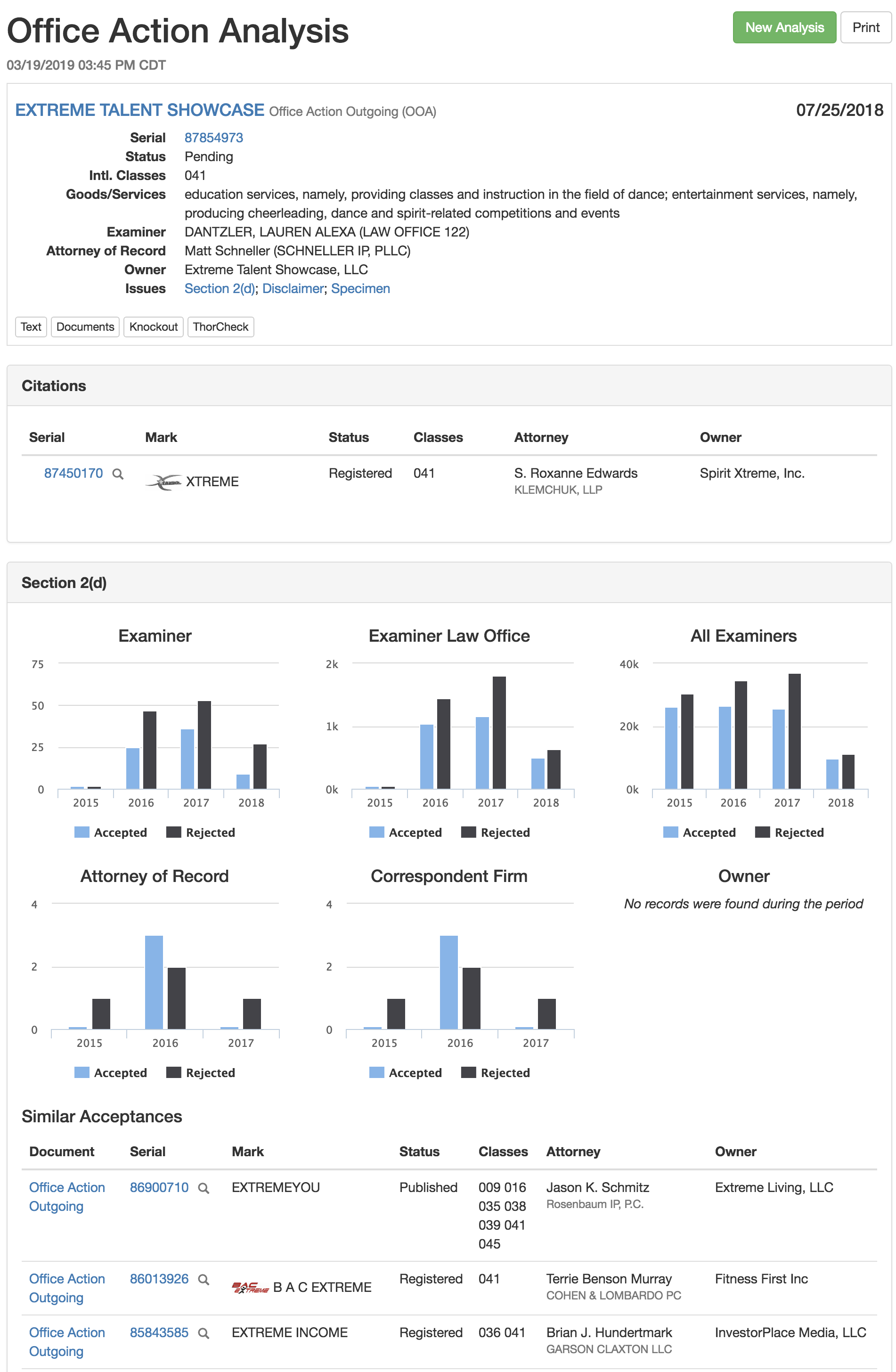
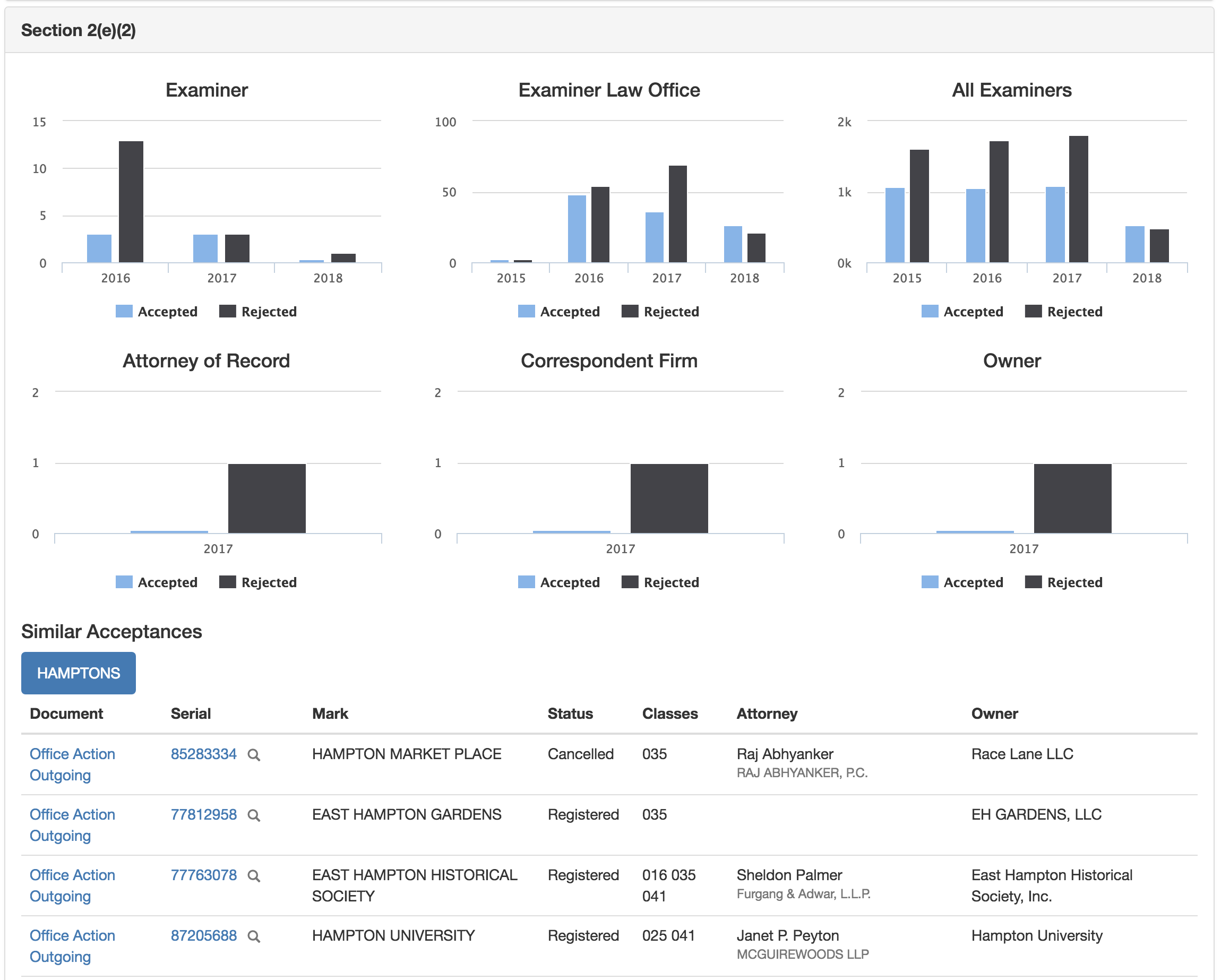
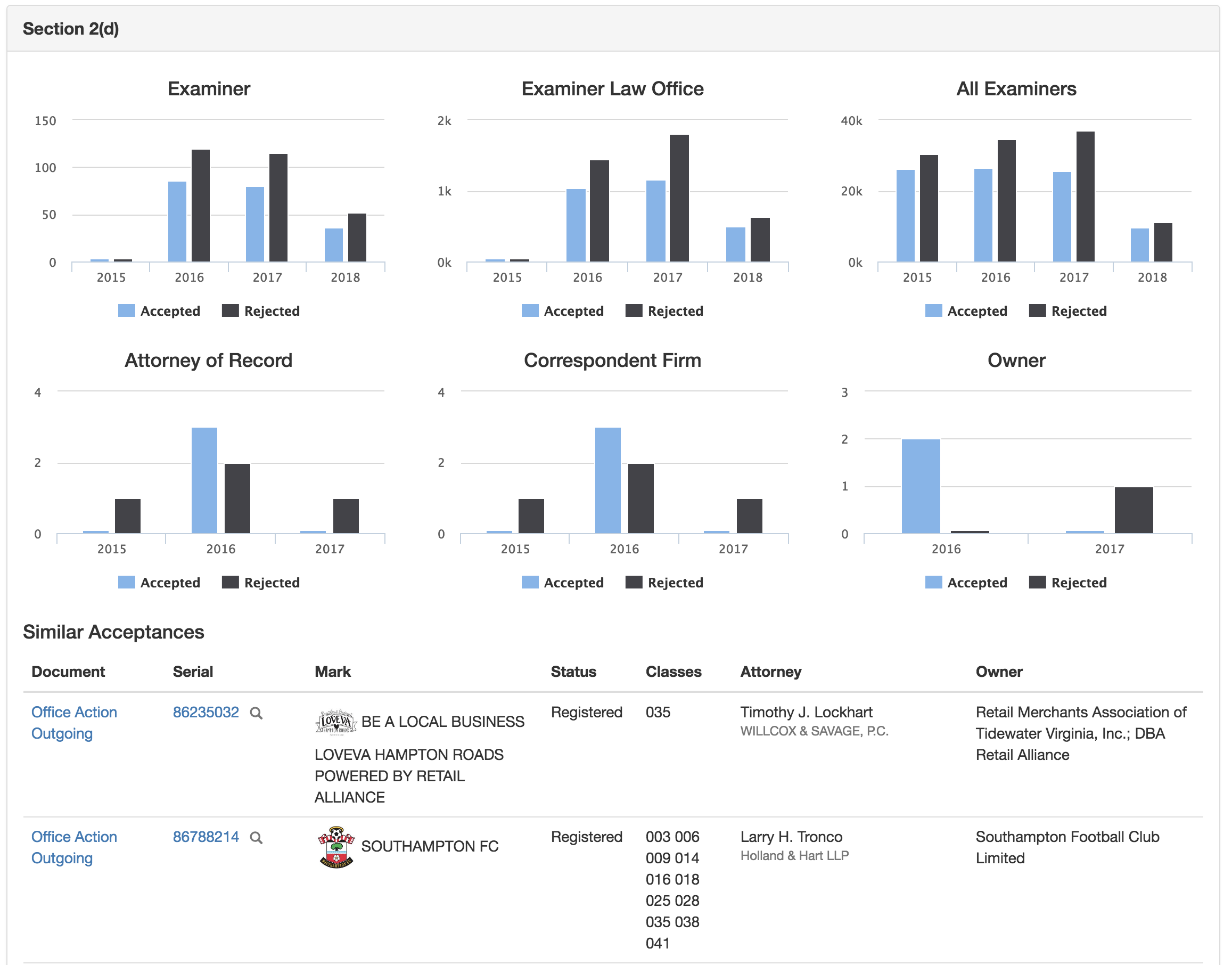
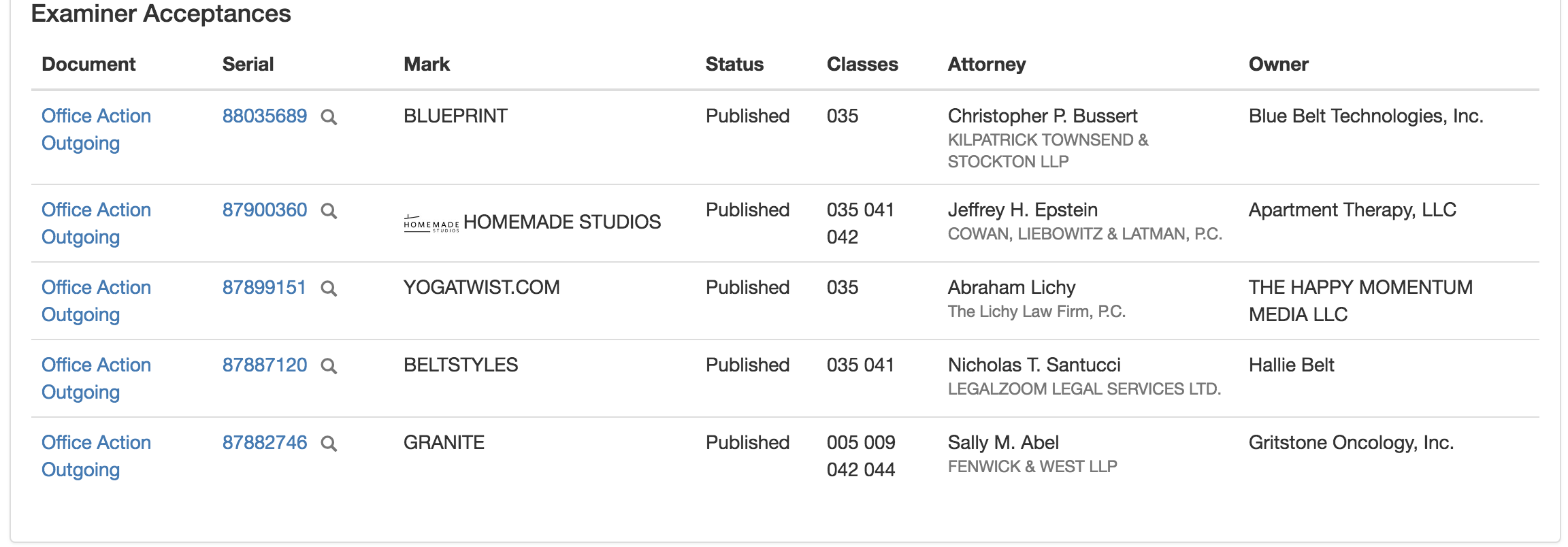
TM TKO has added a bit of additional visibility into filing details in the Office Action Analysis tools’ list of Similar Acceptances (acceptances for similar marks facing the same issue) and Examiner Acceptances (recent acceptances from your Examiner for filings facing the same issue). Now, when you mouse over a class, you’ll see additional details on the goods or services for that application. Keep on the lookout for more updates!
This blog posts looks at TM TKO’s new Office Action Analysis tool in more detail, demonstrating how it can help you build a find key prosecution data and build a strong response more quickly than ever before.
We’ll look at a recent final Office Action issued on March 22, 2019 for the mark KARMA ICE CREAM, Ser. No. 88/249,249. The application, filed by two individuals, covers a variety of frozen confections in Class 30. It raised two issues – 2(d) citations or potential citations to four prior filings, and requested a disclaimer of “ice cream.”
TM TKO Automates Research on the 2(d) Issue
Four prior
registrations or applications were cited as bars: KARMA, registered in Class 30
and 42 (Reg. No. 5431756), GOOD KARMA
(published in Class 30, Ser. No. 86651506) and SWEET KARMA (published in Classes 30
and 5, Ser. No. 87890908), and KARMA KOOKIES (pending in Classes 30
and 16, Ser. No. 88188680).
These citations are
all listed in the “Citations” section of the report, just after the main
application details. Each has a small triangle that can be expanded to show the
full web of prosecution citations.
KARMA registration –
cited against 4 applications, 1 published (SWEET KARMA) and 2 pending
(including KARMA KOOKIES)
GOOD KARMA published
app – overcame citations to two GOOD KARMAL registrations in prosecution; cited
versus published SWEET KARMA and pending KARMA KOOKIES application plus an
abandoned GOOD 420 KARMA application in Class 1.
SWEET KARMA – about
to be registered, no citations in prosecution and only cited against KARMA
KOOKIES and this application.
KARMA KOOKIES – the KARMA registration plus a whole slew of applications with KARMA; no response has been filed yet.
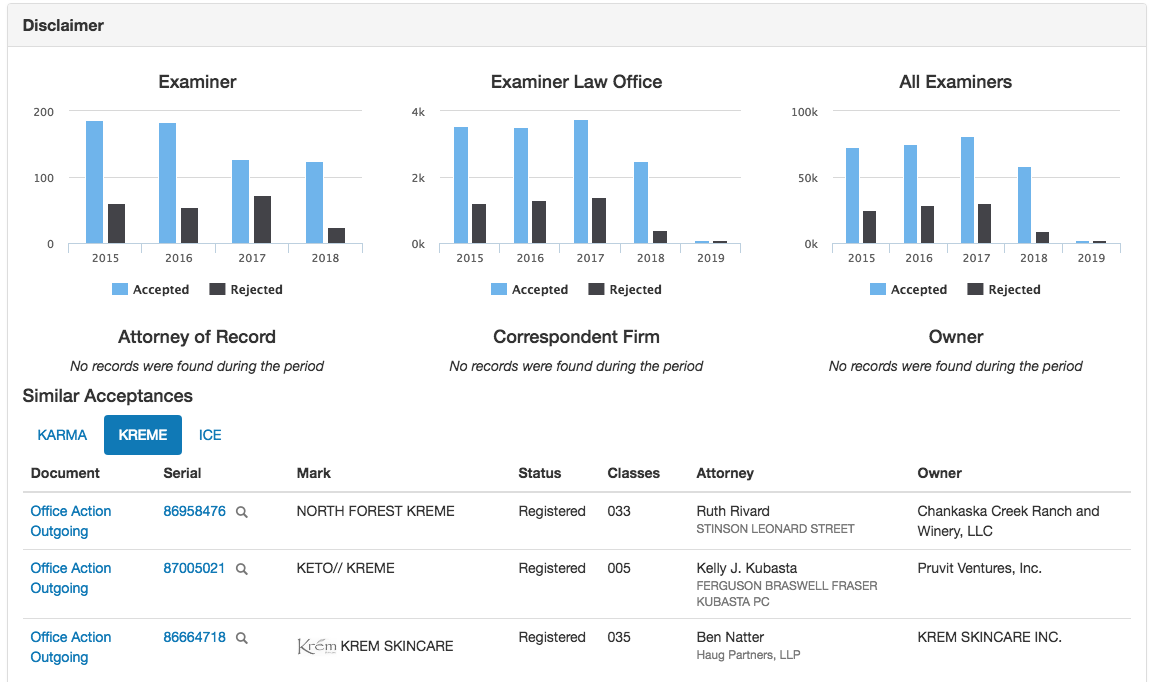
The Examining Attorney statistics suggest that the Examining Attorney of this application upholds initial refusals at a rate roughly consistent with the rate of the Office overall. (If the applicant was represented, you’d see attorney success rates too.)
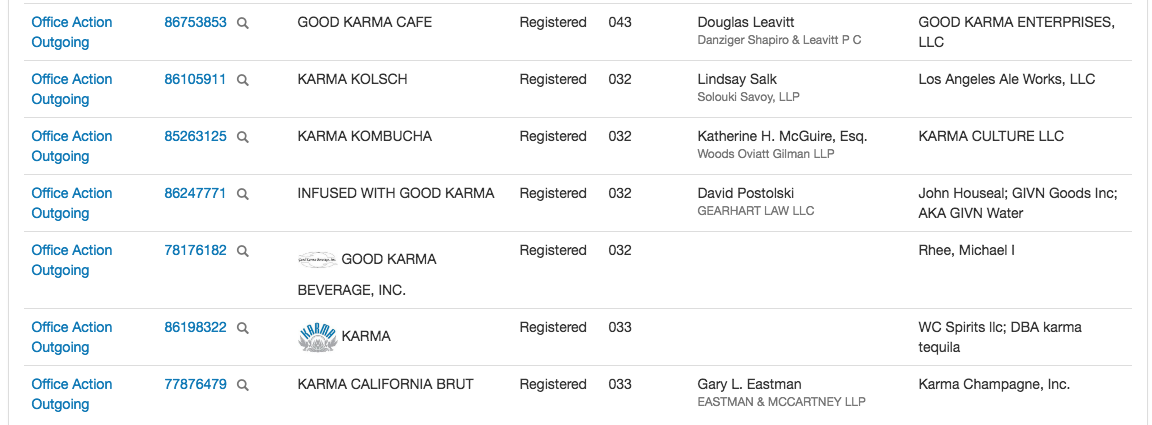
The “Similar Acceptances” section points to helpful Office Actions overcoming comparable refusals, like two registrations for KARMA in Class 29 for differing goods with different owners, for GOOD KARMA CRUNCH in Class 30, for FRUITE KARMA in Class 29, for GOOD KARMA CAFÉ in Class 43, for KARMA KOLSCH and KARMA KOMBUCHA in Class 32 with different owners, and more. The applicants overcame 2(d) refusals based on the term KARMA with a variety of arguments and consent strategies, helping you quickly build persuasive responses on similar facts.
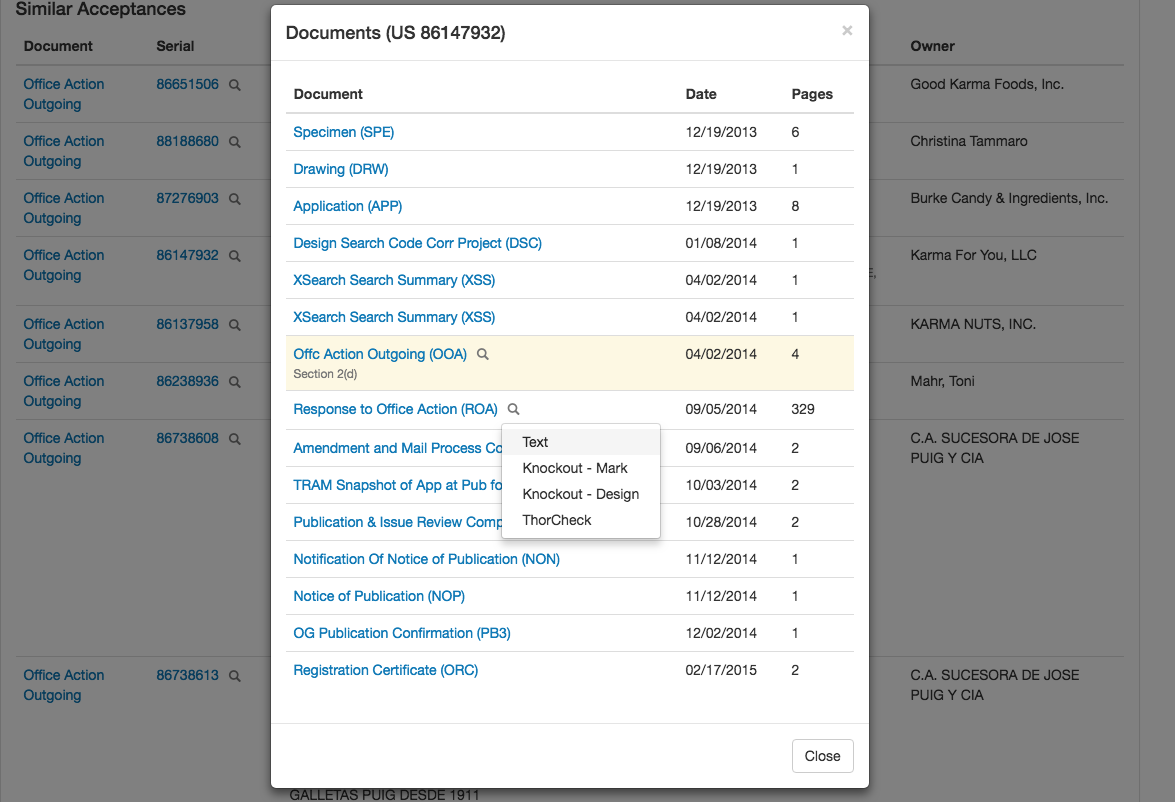
Just click on the magnifying glass, then “Documents,” and either click on the Office Action or response you want to see in PDF format, or click the magnifying glass again to get to a plain-text version.
Below this, the “Examiner Acceptances” section will point you to recent acceptances after 2(d) refusals for this Examining Attorney, which can provide additional insight into the types of arguments that the Examining Attorney may find especially helpful.
ICE CREAM Disclaimer Request
There isn’t a
service out there that can help you from having to enter a disclaimer of “ice
cream” where “ice cream” is generic for the goods, but TM TKO does help as best
it can. The “Disclaimer” section is organized by term.
Clicking on KREME
shows you three examples of applicants getting marks that contain KREME or
close variants through on the Principal Register without a disclaimer after
facing a disclaimer request, all in related classes.
This lets you rapidly view the best-case outcomes, and decide whether to pursue similar arguments. You can click on the magnifying glass and dig into the file histories of each. The registrations for NORTH FOREST KREME and KETO/// KREME, for example, both disclaim exclusive rights in “cream,” suggesting that the Examiner’s approach here is likely to hold up.
As above, clicking in on the magnifying glass to find additional details and do deep dives in file histories to learn more.
We hope the automated research provided by TM TKO’s Office Action Analysis tool is a huge boon to your practice, helping you do better legal research and drafting faster than ever before. Start playing with the Office Action Analysis tool now, and you have any questions, don’t hesitate to contact us at support@tmtko.com.
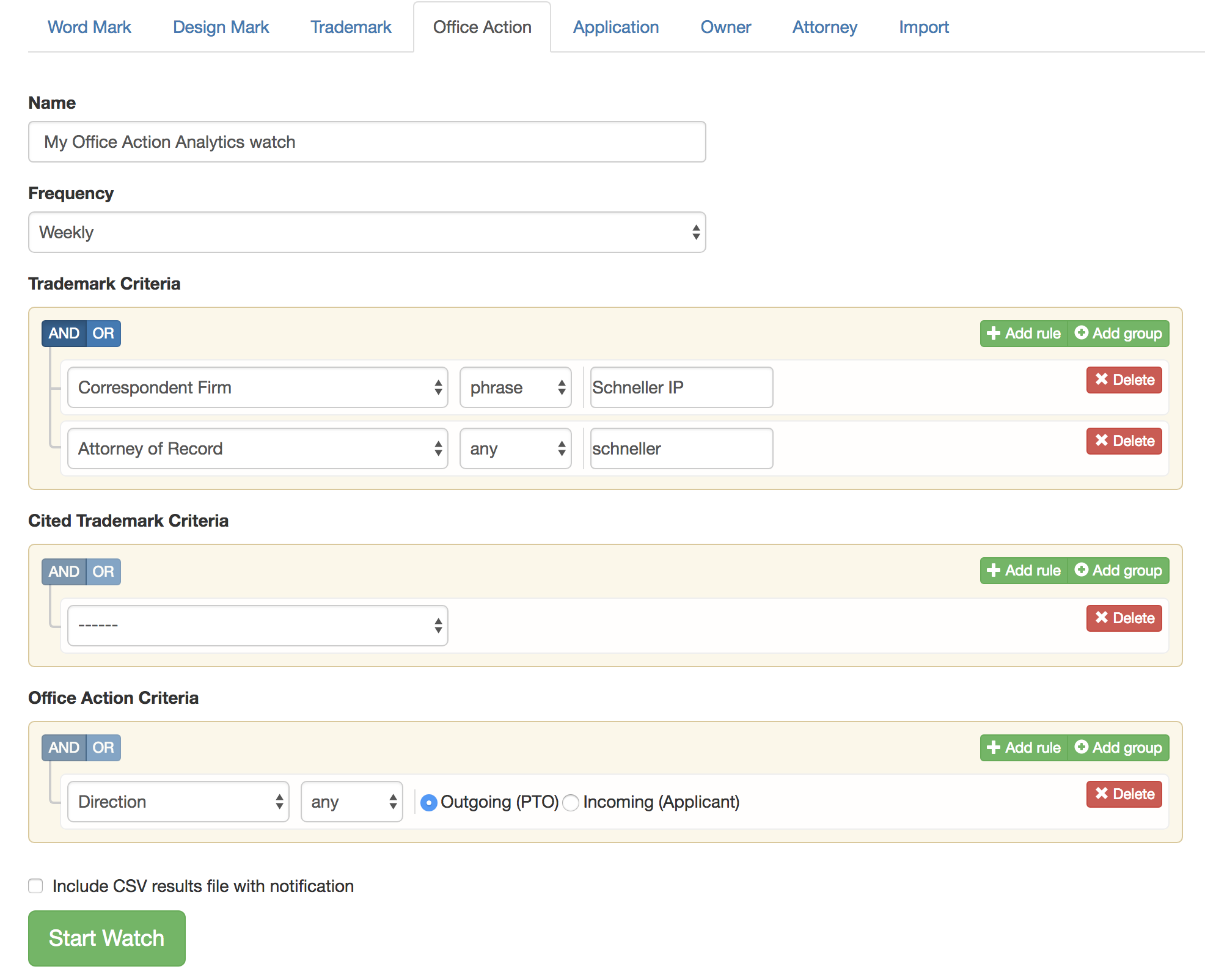
It’s simply to access Office Action Analytics for your portfolio via TM TKO’s Watch tools. Go to the “Watch” page, select “New Watch,” then select “Office Action” – or just click here.
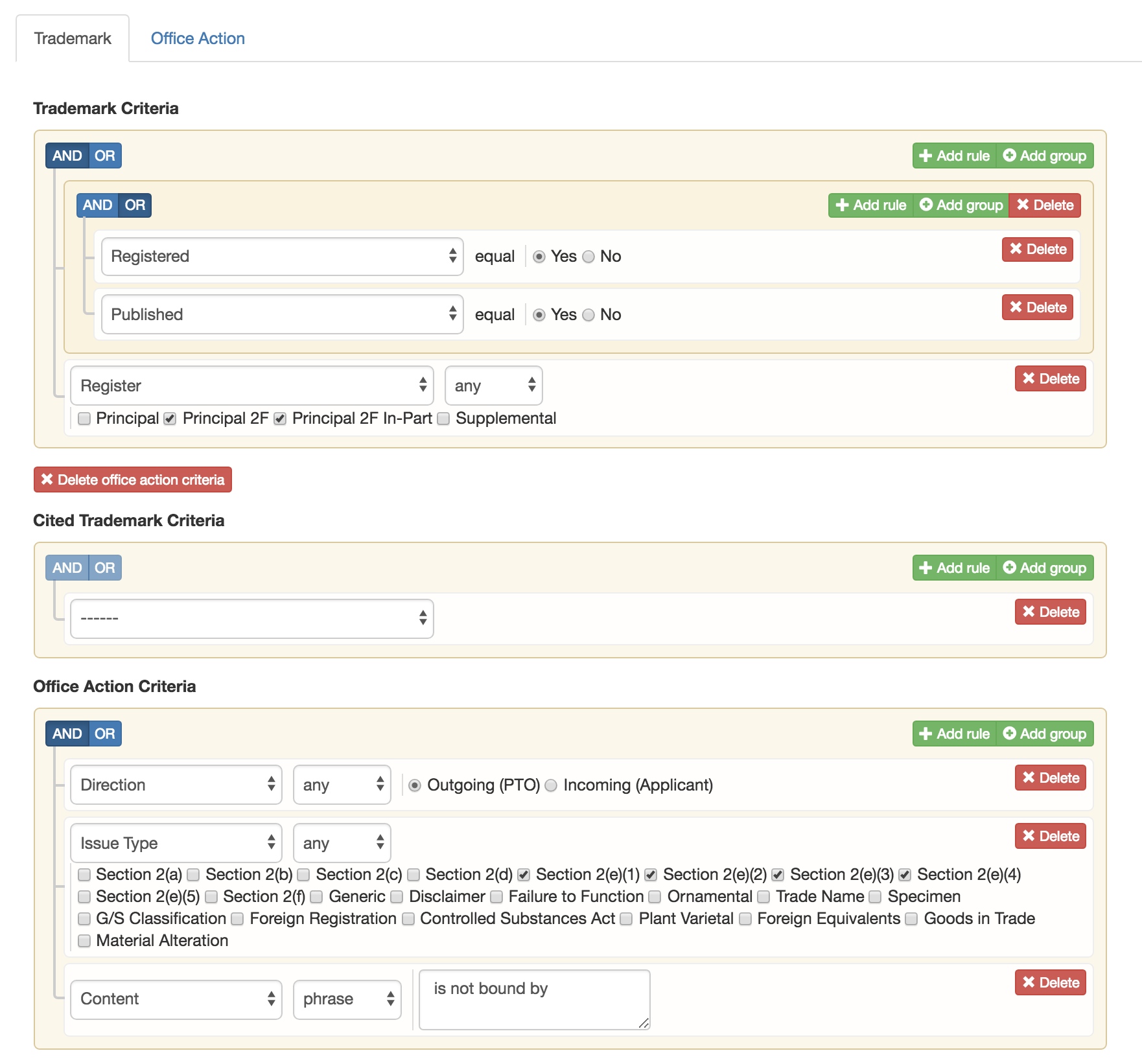
Under “Trademark Criteria,” add some constraints to limit results to just Office Actions that you care about. You have a few options. If your email address is used in the correspondence field, that’s the simplest way to set it up.
Or, you can pair up your firm name (use “phrase” if you have a common term) and your last name. You can use a firm email extension or docketing email address plus your last name, too.
However you have yourself identified in the “Trademark Criteria,” make sure to go down to “Office Action Criteria. Select “Direction” and limit to “Outgoing” correspondence from the USPTO.
If you get an Office Action, you’ll get an email report with a link into the system. It’s just a click from there to access the file history or get to the full analytics report, as shown below.
The Office Action analytics report will give you Examiner data and selected successful responses, targeted to your facts, prevailing on similar arguments. TM TKO is the only place to find this kind of trademark research, and it’s so easy that you can’t help but do your best work.
We hope you enjoy the new tools. If you have any questions, don’t hesitate to email us at support@tmtko.com.
If you are not a subscriber yet, you can try for free for 30 days at https://www.tmtko.com/signup. TM TKO is very cost-efficient: a 24 hour day pass is $75. Subscriptions start at $250 per month or $2500 per year for one seat, and include unlimited use of all search, research, and watch tools.
TM TKO’s new Office Action analytics let you prepare smarter, better Office Action responses in less time. Our tools do the complex research for you, instantaneously. See a full example of the kind of Office Action analytics that TM TKO provides, or try it now from your Tools menu.
Issue-driven analysis: instantly provides you successful responses for similar marks for similar products or services to help you build on the successes of others. Pull any TSDR document in formatted PDF or plain-text format.
Examiner details: compare your Examining Attorney’s allowance rates on this issue with others in that Law Office and at the USPTO overall, and see recent successful responses for your issue and your Examiner.
Citation histories: do deep dives into citation histories at a click. It’s easy to understand complex webs of co-existence, assess your own chances of success, and see how the cited prior filings have interacted with other applications.
ThorCheck
Office Action analysis integrates with ThorCheck, TM TKO’s ground-breaking comparative research tool based on a precedential TTAB opinion, to find examples of co-existence of the same mark for two sets of goods with different owners. This evidence helps you push back against likelihood of confusion claims. You can also use ThorCheck to provide confusion evidence as the senior party in a Letter of Protest or opposition. Search Upgrades
Office Action and prosecution data is now integrated across our platform.
Results in knockout search, manual search, and watch results all feature easily accessible citation data, full TSDR file histories with Office Actions and Responses tagged by issue, and quick links to prosecution analysis. Just click on the magnifying glass icon for a wealth of research options.
A statement that your current Examining Attorney “is not bound by the prior decisions” of other Examining Attorneys is an invariable source of frustration to applicants and their counsel. Building off a long line of cases, most recently, In re Nett Designs, Inc., 236 F. 3d 1339, 57 USPQ2d 1564, 1566 (Fed. Cir. 2001), Examining Attorneys and the TTAB have a wide scope of discretion to ignore the prior examination decisions on highly similar facts but not quite identical records.
We ran some numbers to quantify the impact. (Sample search
strategies are below, at note 1.) Compared to the all applications,
applications where the Examining Attorney says he or she “is not bound by”
prior examination outcomes are about 5-6% more likely to have “bad” prosecution
outcomes for the applicant. Abandonment rates pre-publication and
pre-registration for 2(d) refusals were 5% higher, as were abandonments for
2(e)(1)-(4) refusals. Rates of acceptance on the Principal Register or with a
2(f) claim were also down 5-6% each.
This is highly counter-intuitive – the “is not bound by” language basically only arises in second or final Office Actions, and only comes up in situations where the applicant believes that a prior examination result (often for the same or similar mark owned by the applicant) should dictate the result of examination here. If anything, if the Office was aiming for consistency, we would expect more favorable results for applicants on this type of fact pattern.
2(d) “not bound”
2(d) – all
Difference
Registered or Published
39%
44%
5%
Dropped Pre-Pub or
Pre-Registration
61%
56%
5%
2(e)(1), (2), (3), or (4) “not bound”
2(e)(1), (2), (3), or (4) – all
Diff.
Registered or Published –
Principal
10%
15%
5%
Registered or Published –
2(f) claim or claim in part
5%
11%
6%
Registered – Supplemental
24%
19%
5%
Dropped Pre-Pub or
Pre-Registration
60%
55%
5%
The Trademark Trial and Appeal Board recently provided a tiny glimmer of hope amongst this entirely unnecessary fog – In re The Random Acts of Kindness Foundation, Ser. Nos. 87245967, 87245971, 87245973, and 87245975 (TTAB Feb. 15, 2019), available athttp://ttabvue.uspto.gov/ttabvue/ttabvue-87245967-EXA-13.pdf (non-precedential). It is non-precedential, as are far too many TTAB decisions. The Board overturned a “merely informational” refusal, essentially because the applicant had nearly a dozen registrations for its RANDOM ACTS OF KINDNESS mark. The Board critically held that evidence that “random acts of kindness” has lots of non-trademark uses was “previously available” even if it was not part of the formal record in prior examinations, and the Office failed to provide a “reason for its inconsistent treatment” of the present applications from the prior registrations. The Office didn’t even manage to provide a coherent reason for refusing the four applications in the appeal while letting five others that were filed on the same day go through to registration with no issues.
Some of the specific facts, like the number of registrations, are unique to the Random Acts case, but the general principle that an Examining Attorney or the Board needs to show that the sort of evidence on which they are relying for the refusal was not available as of the prior examination would, if adopted more widely, significantly shifts the burden towards encouraging more consistent examination.
It is too early to tell if the decision will have a
substantial impact, but the very earliest signs are encouraging – only two
attorneys, Paul Reidl in arguing
against a specimen-driven 2(e)(1) refusal for PLANT POWERED for pet food and Julie
Hopkins in arguing against a 2(d) refusal of SEV1TECH & Design based on two
prior registrations for SEVONE (suggesting that since a prior application for
the same mark could have been refused on the basis of those registrations was
not, a refusal for the newer application would be inappropriate), have cited to
Random Acts, and it’s too early to
tell the outcome of either.
—-
1 Sample TM TKO search strategy to find filings that were either published or registered with a 2(f) or 2(f)-in-part claim despite getting a 2(e)(1)-(4) refusal and an Office Action with the “is not bound by” language:
Companies whose marks toe the descriptive-suggestive line can have complicated paths to “full” trademark protection on the US Principal Register. Let’s look at one what is now a well-known brand traveled the path to a strong registration portfolio – the house mark for Chipotle, the Denver-based fast Mexican chain. The company now has more than fifty active US filings, about half of which are registrations for its house mark or stylizations thereof. Andrew Roppel of Holland & Hart’s Boulder Office is the filing correspondent for the company’s US marks.
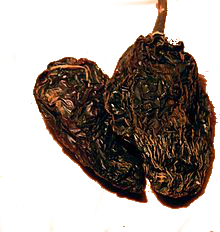
Chipotle’s first trademark registration was for CHIPOTLE MEXICAN GRILL & Design, shown below. The full prosecution history has never been scanned by the USPTO, but the application was filed in 1994 based on use since the prior year; a registration eventually issued on the Supplemental Register in late 1995. Why did it end up on the Supplemental Register? A chipotle pepper is a dried, smoked jalapeno pepper, either used on its own or packed in a spicy adobo sauce often used in Mexican cuisine, including in some of Chipotle Mexican Grill’s own food.
The company revisited its trademark portfolio in 1998, filing for the logo above, the word mark CHIPOTLE MEXICAN GRILL, and the word mark CHIPOTLE with 2(f) claims in 1998, eventually obtaining registrations for each in 2000. The company faced a 2(e) refusal for these re-filed applications. In response, it submitted extensive arguments arguing that CHIPOTLE was suggestive rather than descriptive, but the Office continued to refuse the mark as merely descriptive. A 2(f) claim based solely on 5 years’ use was sufficient to move forward to registration.
At the same time, the Office requested that the company disclaim CHIPOTLE and MEXICAN GRILL in the combined application. A response making a 2(f) claim and disclaimer of “Mexican Grill” overcame that issue, too.
The company’s expansion into prepared food products in 2005 generated similar issues, although, since the applicant was initially filed as an intent to use application, its 2(f) claim was initially refused on the grounds that (a) “chipotle” was more related to the applied-for foods than even restaurant services, and the distinctiveness for the prior registrations for services would not necessarily translate. The applicant was able to argue around the refusal based on the relationship between the goods and services, without having to fully paper out an evidence-based acquired distinctiveness claim. The application for CHIPOTLE alone for foods also ran into some prior-pending applications for BAJA CHIPOTLE for meat, CHIPOTLE BEEF PATTY for burgers, and CHIPOTLE for pizza, but each of them was abandoned prior to registration – the BAJA CHIPOTLE mark after an opposition by Chipotle Mexican Grill, the other two due to run of the mill prosecution inconveniences.
Chipotle has since obtained numerous registrations for variations of its house mark, all with little fuss – the 2(f) claims aren’t generating push-back from examiners any more, largely because most have probably eaten at a Chipotle restaurant at least once.
If you have a client facing a similar issue, TM TKO helps you research trademark prosecution histories, with more than ten million Office Actions and Responses that are fully searchable by issue, free-text, or any mark criteria that you can think of. Find the best examples of successful responses and evidence, mold the ideas and legal theories to your facts, and do your best work to help your clients succeed.
Here in Nashville, we’re starting to get occasional warm days (and even more occasional dry days), and spring training baseball has arrived with the warmer weather. Our local AAA team, the Nashville Sounds, has a beautiful stadium right next to downtown, and we can’t wait for the season to start.
In honor of the boys of summer, this blog post looks at the key term in team names, and how popular they are as marks not for pro baseball teams. The research looked at singular and plural forms, which probably overcounted Reds and Nationals a bit, but at least this permitted consistent methodology. The Google Books N-gram research doesn’t try to exclude baseball content in the same way, so marks like RED SOX aren’t screen for non-baseball use in the same way.
Twins, Angels, and Nationals were much more common than the median in both lists, with Rays, Athletics, Tigers, Rangers, Pirates, Reds, and Giants substantially above the median on both lists, too. The terms that had the least salience in more general brand use and Google N-gram book usage were Orioles, the two colored Sox, Astros, and Diamondbacks, with Phillies, Marlins, Dodgers, Padres, and Rockies all lower than the median on both, but less dramatically so.
Braves and Brewers were a good bit more common on the brand side than n-grams, and Cubs and Cardinals were the only terms that were noticeably more common from an n-gram perspective (versus the median) than as brands.
It’s rare that someone hasn’t enjoyed some of the writings or fictional worlds of some of the great fantasy authors, like J. R. R. Tolkien, Ursula K. Le Guin, George R. R. Martin, J. K. Rowling, and many more, even including the rare writer who does not use their initials as a part of their name. Let’s look to see how some of the most common tropes from “high” fantasy fiction have turned into brand names.
As it turns out, the frequency with which book authors use each of these terms, as tracked by Google Books N-Gram analysis, is very similar to the frequency with which those terms are using a trademark. On the trademark side, looked at these terms just as stand-alone words; doubtless, there are some additional uses as a part of compound or unitary marks consisting of two or more conjoined terms, but this suffices to show general trends.
Dragon and wizard led the way in both N-Gram use and trademark filings, perhaps not surprisingly. The only exceptions to the order of N-Gram usage were “dwarf,” which was underrepresented in trademark filings (perhaps out of deference to those with achondroplasia or similar conditions), and “hobbit,” which was overrepresented because The Saul Zaentz Company, which acquired some Lord of the Rings-related rights in connection with a 1978 animated film, owns a bunch (in fact, every single active registration or application for that mark) of filings in the US in connection with merchandising deals.
At TM TKO, we are really interested in prosecution trends. Today, we are going to zoom in on one type of refusal – 2(d) likelihood of confusion refusals – in one class, International Class 1. International Class 1 primarily consists of industrial chemicals and similar products.
In particular, we wanted to test out class relationships – how strong was the likelihood of getting a refusal if the prior mark was in-class, was in a coordinated class (but not in-class), or was in an “unrelated” class (not in-class and not in a coordinated class), and how likely were the refusals to “stick” and cause the application to go abandoned?
While fewer than 12% of applications filed at any time received 2(d) citations, the 2(d) citation rate jumps to about 30% from 2014 to the present. It’s perhaps unsurprising that an increasing 2(d) rate results from an increasingly crowded registry.
As for the content of the cited marks, 2(d) refusals were not quite twice as common in the same class (i.e. the prior registration had International Class 1) than in all the classes noted by the Office as “coordinated” classes combined (any of International Classes 5, 17, 35, 42, 44, A, or B). “Out-of-class” citations – all other classes except Class 1 or any coordinated classes – were surprisingly common, with slightly more “out-of-class” citations than in-class citations, and about twice the number of out-of-class citations as coordinated class citations. There are many more marks not in one of Class 1’s coordinated classes than not, of course, which may account for the difference – currently, there are some 67,000 active filings in Class 1, just short of 950,000 in Class 1 or a coordinated class of Class 1, and more than three million neither in Class 1 nor a coordinated class of Class 1.
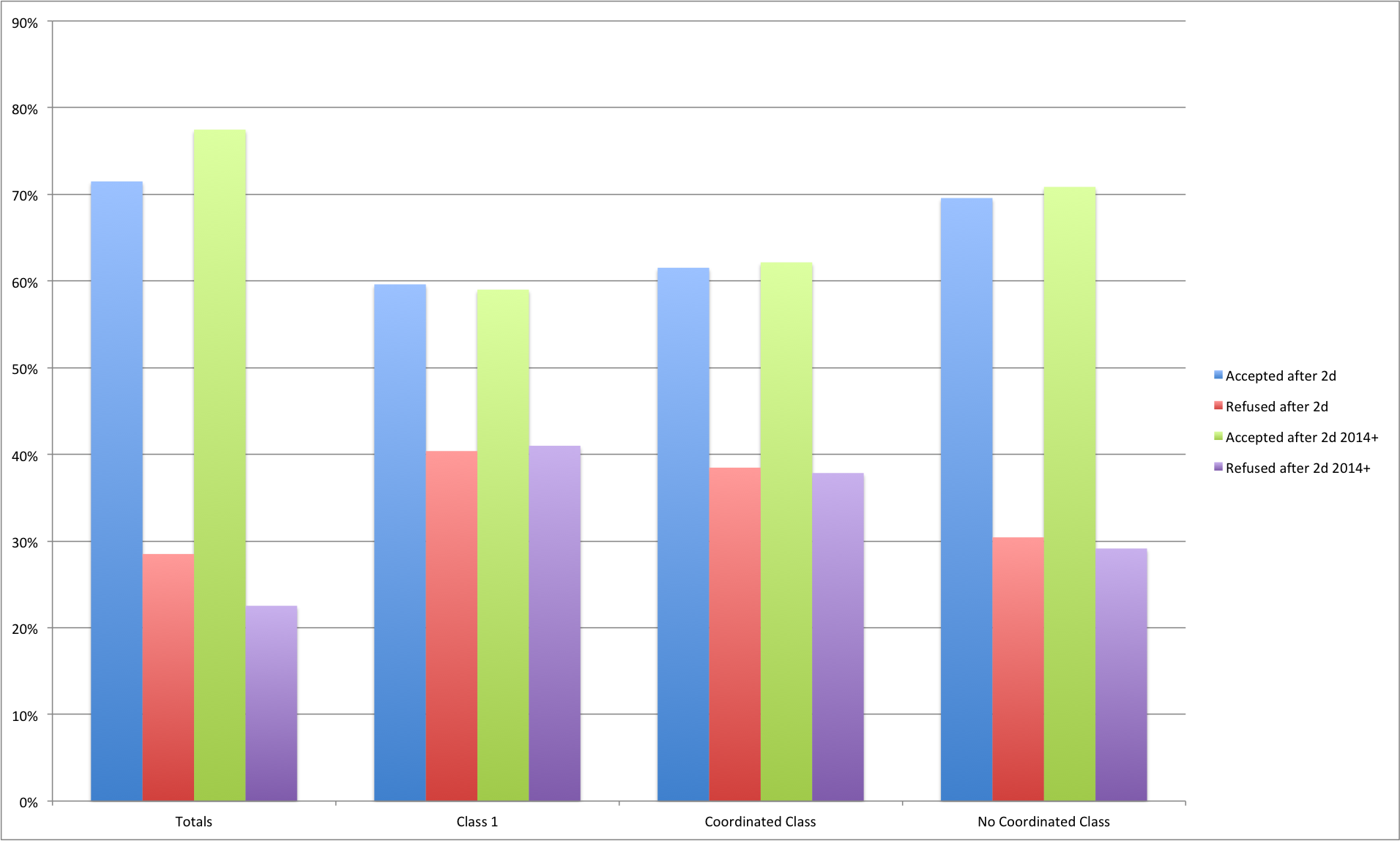
The importance of class and coordinated class are more apparent in looking at how frequency applicants overcome the initial 2(d) citation or citations. Applicants that receive a 2(d) citation in Class 1 or a coordinated class overcome it roughly 60% of the time; applicants that receive a 2(d) citation in an “unrelated” class are about 10% more likely to be successful. The same trends hold since 2014 as over all citations, suggesting that – at least for this class – citations in unrelated classes were noticeably less likely to hold up after further argument by the applicant.
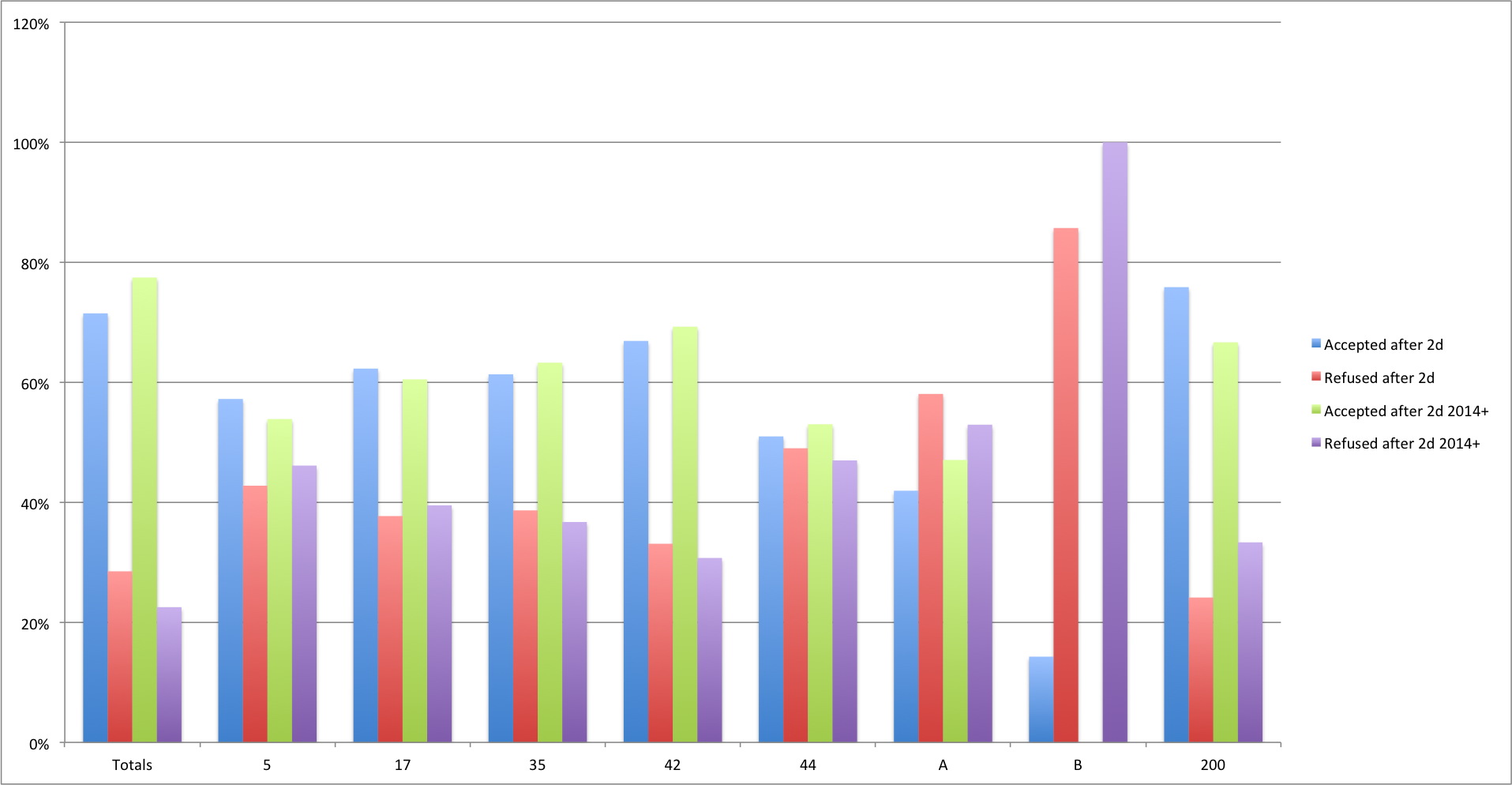
Within the coordinated classes, refusals in Class 1 tended to be the most difficult to overcome; citations to Class 42 (traditionally a grab-bag of services, though now more narrowly defined) and Class 200 were the most likely to be overcome by applicants. Refusals in Classes A and B were less common, but comparatively difficult to overcome, perhaps because they can include especially broad descriptions of goods.
We will be looking at other classes and other prosecution in more depth over the coming weeks and months. If you have specific topics of interest, please let us know at inquiries@tmtko.com.
TM TKO just added a new manual search field – mark length. What can you do with this?
Let’s say you have a client with a two-letter mark – an acronym for their company name. Let’s say your client is a bank – Penny & Associates. It wants to register its PA (stylized) mark. A prior registration for PA (stylized) is owned by Pennsylvania Accountants, Inc. – but with a pretty different stylization. Before you file, you want to see if there are any other examples of co-existence for these same services with other two-letter marks.
With TM TKO, you can find co-existence and find examples of applicants for conceptually similar two-letter marks who faced a refusal — and overcame it.
First things first – let’s find co-existence examples. We’ll search for two-letter terms for “banking” services in Class 36, and limit to use-based registrations (to show actual marketplace overlap). We get 150 different matching results. Sort by mark, so we bring identical marks together, regardless of owner. It’s then simple to tag the overlap. We get a number of examples of co-existence: AB (3 different owners), BB (3), BC (2), C1 (2), CB (8), CC (2), FP (2), FS (3), L1 (2), MM (3), MW (2), PB (3), SC (2), SP (2), SS (2), and UN (2).
See the results:
You can export to Excel or Word, or grab current status and title copies with one click via the TSDR export button to provide your Examiner evidence of the overlap.
If you do the same search for Office Actions (add a “Cited Trademark Criteria” to limit to 2-letter cited marks and an “Office Action Criteria” and the “Issue” as “2(d)”), and you can use a similar search strategy to find other applicants who have overcome similar problems.
TM TKO has allowed direct exports of CSV files from watch via email for several months. By popular request, we have expanded that feature across our toolset.
You can now export results from CSV for: knockout results, manual search results, watch results, and Office Action research results. Just look to your usual “Export” selection list in the top right of your results.
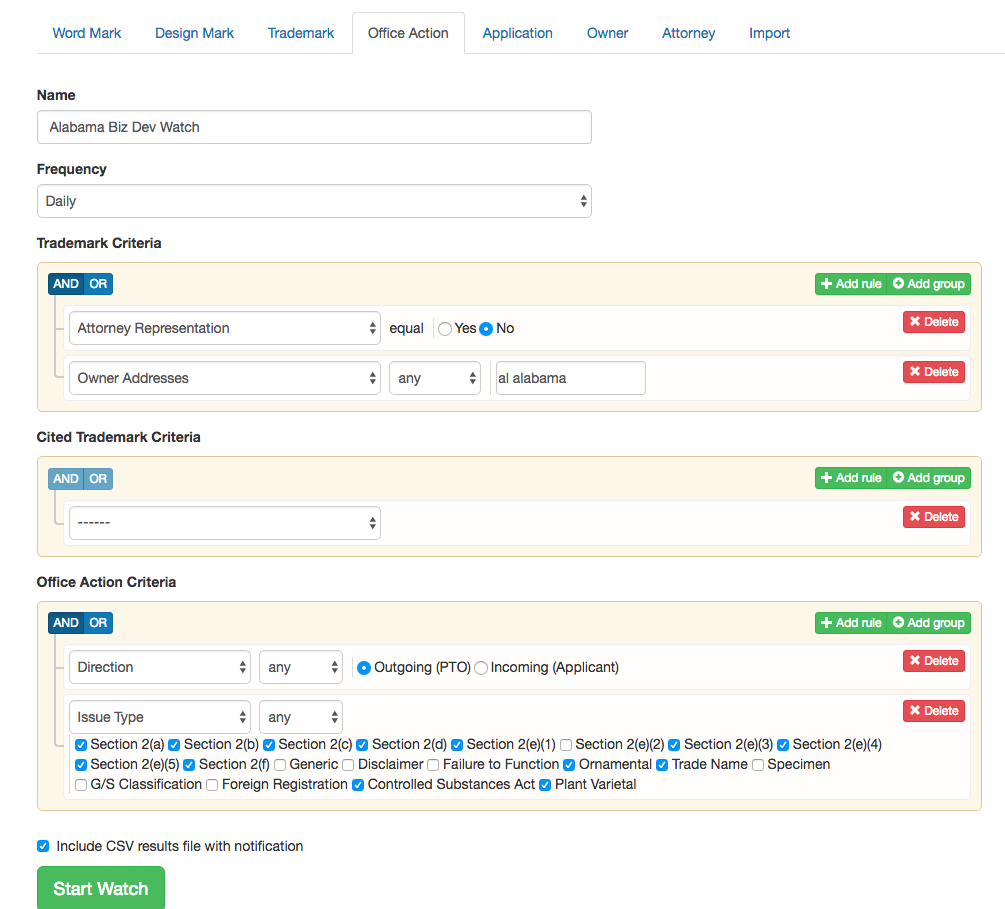
TM TKO’s watch tools are a great way to find new clients, not just to protect your existing clients. Let’s walk through how we can find unrepresented applicants in your area facing complex prosecution problems. Let’s say you are based in Birmingham, AL, and you want to target in-state, unrepresented applicants facing Office Actions.
Go to “Watch” then “New Watch” then “Office Action.” Give your watch a name, like “Alabama Biz Dev Watch.” Pick the frequency you want updates – we will do “Daily” for this example.
Under “Trademark Critera,” select “Attorney Representation” and “No.” This will remove applications that have counsel of record listed. (Some in-house counsel do not use this field, so be sure to take a look.) Click “Add Rule” and select “Owner Addresses,” and add “any” of “AL” or “Alabama.”
Leave “Cited Trademark Criteria” blank.
Under “Office Action Criteria,” add “Direction” and select “Outgoing (PTO)” to see new outbound Office Actions. Then “Add Rule” and add “Issue Type” if you want to limit to only certain types of Office Action content.
If you plan on using a mail merge as a part of your outreach, select “Include CSV results file with notification” and you will get an Excel-style spreadsheet that’s simple to use for custom communications.
A screenshot showing a representative custom watch is below. You can do all sorts of issue targeting, geotargeting, or even focus on upcoming post-registration deadlines using a similar “Trademark” watch – there’s no limit to the opportunities you can uncover.
Of course, be sure to follow your local jurisdiction’s rules about attorney advertising. Good luck finding new clients and expanding your business!












 TM TKO Blog